

Share This Article
For years, contemporary interiors seemed to follow a familiar formula: neutral walls, streamlined furniture, carefully coordinated accessories and as little visual clutter as possible. Gen Z interior design is helping challenge that idea of what a stylish home should look like.
Instead of aiming for a perfectly matched room, many younger decorators are embracing colour, vintage pieces, playful forms, nostalgic references and highly personal objects. The result can be bold and maximalist, but it can just as easily be warm, vintage-inspired or surprisingly traditional.
That is the first thing to understand about Gen Z interior design: it is not one officially defined interior design style.
It is better understood as a group of decorating preferences and evolving Gen Z interior design trends shaped by self-expression, internet culture, nostalgia, affordability and the desire to make even temporary spaces feel personal.
So, what is Gen Z interior design really about, and why is it influencing modern homes in 2026?
What Does Gen Z Interior Design Actually Mean?
The term Gen Z interior design broadly describes interior styles, decorating choices and home decor trends associated with Generation Z.
Pew Research Center has used 1996 as the final Millennial birth year, meaning people born from 1997 onward belong to the following generation commonly called Gen Z. However, Pew is also very clear that generational boundaries are not an exact science and should not be treated as rigid categories.
The same caution is important when discussing Gen Z interiors.
There is no official Gen Z colour palette, furniture style or decorating rulebook. Someone in Gen Z may prefer maximalism, while another may choose Japanese-inspired minimalism, traditional interiors or an earthy rustic home.
What current trend data does show, however, is a strong interest among younger audiences in personalisation, bold colour, vintage finds, playful design and low-cost ways to transform rooms.
Pinterest’s Spring Trend Report for 2026 specifically found Gen Z and younger Millennials personalising their homes through bold colour, vintage pieces and relatively simple “micro-makeovers” rather than waiting for major renovations.
That idea of personalisation is probably the most accurate starting point for understanding Gen Z interior design.
Gen Z Interior Design Is More About Personality Than Perfection
For much of the 2010s, aspirational interiors were dominated by minimalism, pale neutrals and rooms in which almost everything appeared carefully coordinated.
Gen Z design is helping move the conversation in another direction.
Pinterest’s 2026 home trend data describes a move away from perfection towards spaces that express the personality of the person living there. Searches related to the phrase “my room, my rules” increased 415%, while interest also rose around colourful rooms, vintage-style kitchens and small reading spaces.
This makes a typical Gen Z room aesthetic much harder to define visually.
A room might contain an antique wooden table, a contemporary sofa, a bright lamp, a handmade ceramic object and a framed poster from a favourite film. None of these objects necessarily come from the same period or design movement.
What makes the space work is not perfect matching. It has a personal meaning.
That is perhaps the biggest difference between Gen Z interior design and the catalogue-style interiors that preceded it.
Also read – 7 Powerful Lessons from Seoul’s Compact City Architecture for Indian Metros
Bold Colour Is Becoming a Major Part of Gen Z Home Decor
One of the clearest Gen Z interior design trends in 2026 is the return of stronger colour.
ELLE Decor’s 2026 report on Gen Z design trends identified bold colours as one of the major directions designers are observing among younger clients. The same report highlighted colour as a way of giving interiors emotional character and a stronger sense of identity.
That does not mean every Gen Z home is covered in bright red, cobalt blue and lime green.
Instead, colour is becoming less restricted.
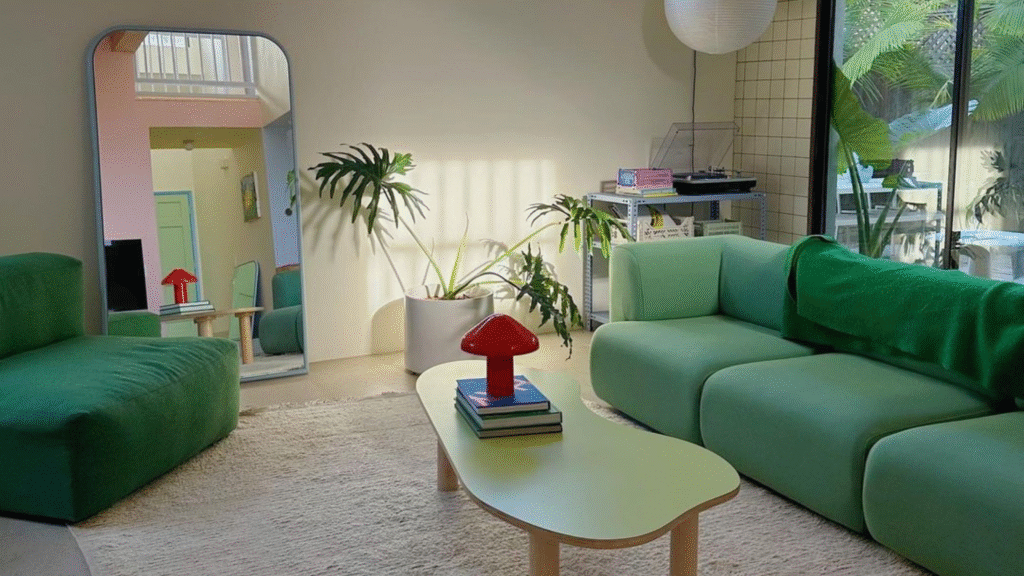
A deep burgundy cabinet, blue sofa, yellow lamp, pink kitchen or green-painted doorway can become the feature around which a room develops.
Pinterest’s 2026 data tells a similar story. Searches increased for colours and schemes including aubergine kitchens, moody blue kitchens and vintage pink kitchens, suggesting a broader appetite for homes with more visual personality.
For Gen Z home decor, colour is often not simply an accessory added at the end.
It can become the starting point.
Dopamine Decor Overlaps With Gen Z Design, But They Are Not the Same Thing
The phrase dopamine decor is frequently mentioned alongside Gen Z interior design, and the two certainly overlap.
Dopamine decor is a popular design term used for interiors centred on colour, pattern, sentimental objects and things that personally bring pleasure to the homeowner. Architectural Digest and ELLE Decor have both covered the trend as a reaction against highly restrained, neutral interiors.
However, dopamine decor should not be treated as another name for Gen Z interior design.
People of any generation can embrace it, and not every Gen Z interior is brightly coloured or maximalist.
The connection comes from a shared philosophy: decorating around what you genuinely like rather than what an interior is supposedly meant to look like.
That might mean a striped armchair, colourful glassware, a strange-shaped lamp, framed childhood artwork or a collection of objects that would never appear together in a conventional furniture catalogue.
The most successful dopamine decor interiors are not necessarily chaotic. They still use composition, proportion, lighting and repetition.
They simply allow joy and personality to influence those decisions.
Vintage Furniture Is Giving Gen Z Homes More Character
One of the more interesting developments in modern Gen Z interior design is that “young” no longer automatically means “new.”
Vintage furniture, antiques, thrifted objects and traditional decorative details have become increasingly visible in younger interiors.
Pinterest reported particularly strong interest in thrifted home decor among Gen Z in its 2025 trend research, including rising searches around thrifted apartments, thrift decor ideas and second-hand room decor. Its 2026 home report has continued to highlight vintage finds as part of younger users’ interest in personalised rooms.
ELLE Decor has also explored the increasing interest of younger decorators in traditional furniture, flea-market finds, vintage textiles and antiques, while importantly noting that design taste cannot simply be divided by age.
That last point matters.
Vintage decor is not inherently a Gen Z trend. What is interesting is the way younger decorators are combining old pieces with contemporary furniture instead of recreating a completely historical interior.
A vintage chest of drawers might sit beneath abstract artwork. An old patterned rug could anchor a modern sofa. A traditional picture frame might surround an unexpected graphic print.
The contrast makes the room feel collected rather than purchased all at once.

Y2K Interior Design and Nostalgia Are Still Influencing Gen Z Rooms
Few generations have experienced nostalgia in quite the same way as people who grew up with the internet constantly documenting previous decades.
That helps explain why Y2K interior design, 1990s references and childhood nostalgia continue to appear in younger interiors.
Architectural Digest documented the rise of what it called “nestalgic” decorating in 2026, particularly among Gen Z and younger Millennials who were incorporating toys, DVDs, posters, older technology and other childhood objects into adult rooms.
This does not mean every Gen Z bedroom is trying to look exactly like the year 2002.
Modern Y2K interiors often reinterpret the period.
Chrome, transparent materials, bright plastics, metallic finishes, playful lighting and early-digital graphics may appear alongside much older furniture or completely contemporary design.
That mix is important.
Gen Z interior design tends to remix nostalgia rather than reproduce it perfectly.
A room can reference the past while still looking unmistakably current.
Curved Furniture and Postmodern Shapes Are Replacing Rigid Interiors
If there is one furniture trend that fits neatly into the Gen Z design conversation, it is the return of curves.
Rounded sofas, chunky chairs, irregular mirrors, scalloped edges, wavy rugs and sculptural tables have become increasingly common across contemporary interiors.
ELLE Decor’s 2026 Gen Z trend report specifically connects younger audiences with renewed interest in Postmodern and Memphis-inspired design, including rounded silhouettes, squiggly patterns and unconventional shapes.
These styles originally became prominent decades ago, so describing them as new would be incorrect.
What is new is the way their visual language is being rediscovered and remixed.
The appeal makes sense within the wider Gen Z aesthetic.
A strange-looking lamp or unusually shaped chair creates an immediate focal point without requiring an entire room renovation.
For smaller apartments and bedrooms, one expressive furniture piece can completely change the atmosphere.
Gen Z Maximalism Is More About Curation Than Simply Owning More
Gen Z interior design is often described as maximalist, but that description needs some nuance.
Maximalist interior design uses layers of colour, artwork, texture, pattern and decorative objects to create visually rich spaces. It has become increasingly prominent within contemporary design generally, not only among Gen Z.
Architectural Digest’s wider 2026 interior forecast, for example, predicted stronger maximalism, saturated colour and highly personalised spaces across the design industry.
For younger decorators, however, maximalism often takes a particularly personal form.
Books remain visible. Photographs stay on the wall. Travel souvenirs, collectibles, ceramics, artwork, records and objects connected with hobbies become part of the room rather than disappearing into closed storage.
Sometimes this aesthetic is described online as cluttercore, but a room does not have to be cluttered to feel layered.
The stronger idea is curation.
Instead of removing every object that does not fit one carefully controlled aesthetic, Gen Z interiors often allow different parts of someone’s life to remain visible.
Social Media Has Completely Changed How Interior Trends Spread
It is impossible to discuss Gen Z interior design trends without discussing social media.
Pinterest, TikTok, Instagram and other visual platforms allow people to discover interior references almost immediately, whether those references come from a famous designer, a historic house or somebody decorating a tiny rented bedroom.
Pew has noted that constant connectivity and social media have been part of life from an early age for people born after the Millennial generation, while Architectural Digest has examined how Pinterest, Instagram and TikTok shape younger consumers’ furniture choices and design aesthetics.
This has created an enormous visual vocabulary.
Terms such as cottagecore, dopamine decor, dark academia, Y2K, maximalism, cluttercore and numerous other “aesthetics” can circulate globally within days.
But there is also a contradiction.
When everybody receives inspiration from the same algorithms, supposedly individual spaces can start to resemble one another.
Architectural Digest has previously highlighted precisely this tension: social media makes design inspiration far more accessible, but repeated exposure to the same spaces and objects can also create visual sameness.
The most interesting Gen Z interiors therefore do not simply copy an aesthetic.
They remix it.
Renter-Friendly Interior Design Has Become an Important Gen Z Influence
Not every young decorator can repaint an entire house, replace flooring or remodel a kitchen.
That makes smaller, reversible changes particularly relevant to Gen Z interior design.
ELLE Decor’s 2026 Gen Z trend report identifies renter-friendly redesigns as one of the year’s significant trends, with younger renters using textiles, colour and cosmetic changes to personalise otherwise plain spaces.
Pinterest’s 2026 trend report similarly points towards “micro-makeovers” and relatively low-effort changes rather than waiting for a dream house or major renovation.
This can include rugs, artwork, removable elements, freestanding furniture, lamps, curtains, cushions and painted details where permitted.
The design lesson is useful even for homeowners.
A space does not always need a large budget or architectural intervention to feel different.
Sometimes changing the lighting, adding one vintage piece or introducing a strong colour can give a room a completely new personality.
Small Lamps and Softer Lighting Fit the Gen Z Mood
Lighting is another area where younger decorating trends have become particularly visible online.
ELLE Decor identified the dislike of harsh overhead lighting and the preference for multiple smaller lamps as a Gen Z-associated trend in its 2025 reporting.
The approach uses table lamps, floor lamps and accent lights to create several pools of light rather than depending entirely on one bright ceiling fixture.
This is not an exclusively Gen Z lighting technique; interior designers have used layered lighting for decades.
What makes it relevant to Gen Z decor is how strongly the idea has travelled through social media culture.
A mushroom-shaped lamp, colourful lampshade or sculptural floor light can provide both illumination and personality.
In smaller spaces, lighting becomes decoration as much as function.
Gen Z Bedrooms Have Become a Major Canvas for Personal Expression
The Gen Z bedroom aesthetic is one of the most visible versions of this design movement because bedrooms allow experimentation without requiring an entire house to change.
Posters, bedding, lamps, photographs, mirrors, small rugs, artwork, shelves and collectables can create a very strong visual identity even when the architecture of the room remains basic.
Pinterest’s rising searches around personal rooms and small reading corners support this wider desire to customize limited spaces, while Architectural Digest’s coverage of nostalgic bedrooms shows how personal memorabilia can become an intentional part of adult interior design.
The result is often much more autobiographical than conventional bedroom styling.
The room reveals music tastes, favourite films, hobbies, memories, colours and references rather than hiding them in the name of visual simplicity.
That is why Gen Z bedroom decor ideas can vary so dramatically from person to person.
Personalisation, rather than one recognisable aesthetic, is the common thread.
Is Gen Z Really Rejecting Minimalism?
Not exactly.
Saying Gen Z has rejected minimalism would be an oversimplification.
There are plenty of younger people who prefer clean, neutral and highly restrained interiors. There are also Millennials who love maximalism and older homeowners who embrace colourful, unconventional rooms.
Pew Research Center specifically warns against turning generations into simple caricatures because differences within a generation can be just as significant as differences between generations.
What does appear to be changing is the assumption that contemporary design must automatically look minimalist.
Colour, vintage furniture, ornament, pattern and sentimental objects have regained permission to appear in fashionable interiors.
That wider change reaches far beyond Gen Z.
Gen Z may simply be one of the groups accelerating it.
Gen Z Is Beginning to Influence the Renovation Market Too
Gen Z’s relationship with interiors is no longer restricted to rented bedrooms and temporary apartments.
Some older Gen Z adults are becoming homeowners and renovators.
According to the 2026 U.S. Houzz & Home Study, Gen Z homeowners represented just 0.5% of renovators in its U.S. sample, so they remain a very small portion of the renovation market. However, among Gen Z renovators surveyed, 76% undertook interior-room remodels, the highest share of any generation in the study.
That statistic needs to be interpreted carefully.
It is U.S.-specific Houzz research, and it does not prove that one particular Gen Z design aesthetic will dominate future homes.
What it does show is that older members of the generation are beginning to move from decorating temporary spaces to making larger decisions about permanent interiors.
That makes their preferences increasingly relevant to architects, interior designers, furniture brands and homeowners.
What Will Gen Z Interior Design Look Like Beyond 2026?
Predicting one future Gen Z interior style would miss the entire point of the movement.
The strongest current evidence suggests that younger decorators value the ability to change, reinterpret and personalise their surroundings rather than permanently subscribing to one aesthetic.
Pinterest’s wider 2026 trend forecasting describes personal expression increasingly through remixing rather than copying, while its spring home report emphasises rooms shaped around the person occupying them.
That could mean today’s dopamine decor becomes tomorrow’s traditional maximalism.
Y2K elements might disappear while vintage timber furniture remains. Bright colours could become darker and more sophisticated. Postmodern shapes may eventually give way to another rediscovered historical movement.
The individual trends will change.
The desire for individuality probably matters more.
So, What Is Gen Z Interior Design Really?
Gen Z interior design is not simply colourful furniture, maximalism or quirky lamps.
It is an approach to decorating that increasingly prioritises self-expression, flexibility, nostalgia and personality over following one perfectly coordinated style.
Bold colours can sit beside vintage furniture. Traditional objects can appear with futuristic lighting. Childhood memorabilia can become decoration. A rented apartment can develop a strong visual identity without an expensive renovation.
Some Gen Z homes will be colourful and chaotic.
Others will be muted, traditional or minimalist.
That diversity is exactly why Gen Z interior design should not be reduced to another internet aesthetic.
The larger influence is the freedom to combine references without constantly asking whether everything “matches.”
After years in which aspirational interiors often meant neutral colours, empty surfaces and carefully coordinated furniture, homes are becoming personal again.
And perhaps the most powerful Gen Z interior design rule is that there does not have to be a rule at all.