
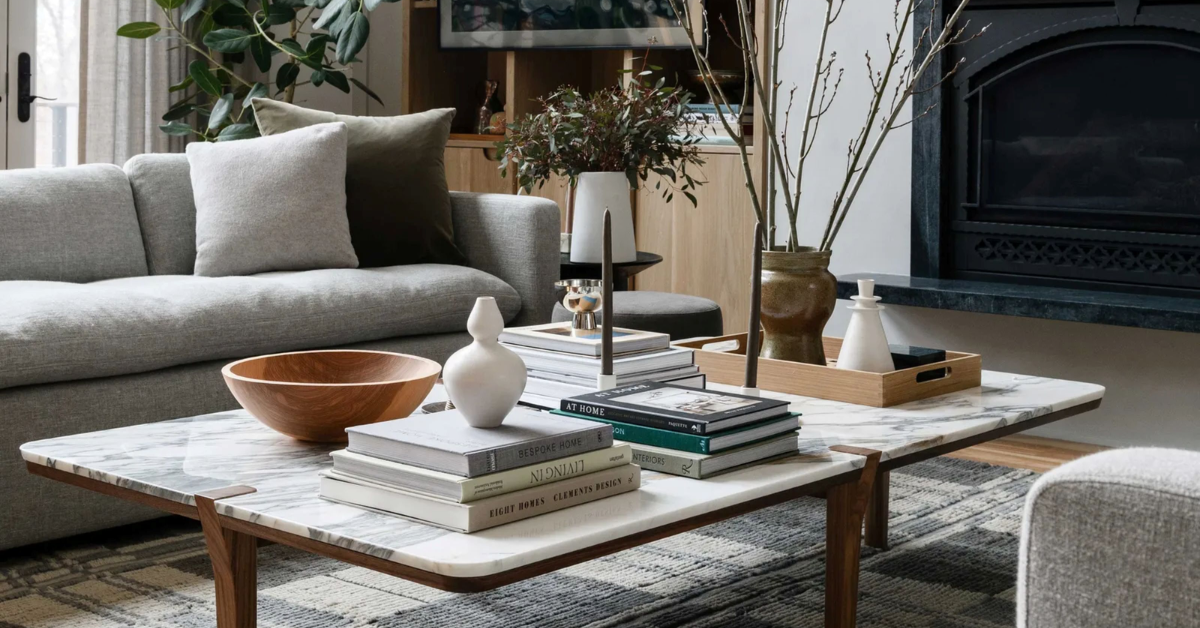
A beautiful room is not only about good furniture, colours and accessories. How you group, space and balance those pieces changes how the whole room feels. The 3-5-7 rule in interior design is a simple styling guideline that helps you arrange decor in a more thoughtful way.
In short, the 3-5-7 rule says to group decorative objects in odd numbers, usually three, five or seven, instead of pairs or even sets. This creates a relaxed, balanced look with a mix of heights, shapes, materials and visual weight.
The rule is not a strict formula. You do not need exactly three, five or seven items on every surface. Scale, proportion, empty space and the overall style of the room matter far more than the count.
What Is the 3-5-7 Rule in Interior Design?
The 3-5-7 rule suggests arranging decor in groups of three, five or seven rather than defaulting to even numbers.
- Three items suit a small side table or nightstand.
- Five items suit a larger coffee table or a fireplace mantel.
- Seven items can work on a long console, a big shelf or a wide display, as long as there is enough room.
The goal is not to cover every surface. It is to give your decor a clear order and rhythm. Designers also advise against using identical objects. A vase, a stack of books and a low bowl make a better group of three than three matching pieces lined up in a row.
Why Odd-Numbered Groupings Work
Odd groupings make it easy to build asymmetrical arrangements. Symmetry splits a composition evenly and feels formal, orderly and calm. Asymmetry lets objects of different sizes balance each other without mirroring.
Neither is better. Matching lamps beside a bed, two armchairs facing a sofa, or sconces on either side of a mirror all look great and are symmetrical. The 3-5-7 rule helps when you want a space to feel more casual and layered, such as on shelves, coffee tables, consoles and mantels.
The value of odd numbers lies in flexibility, not in odd being better than even.
The Rule of Three vs the 3-5-7 Rule
The rule of three is the older and better-known idea. It groups items in trios, such as vases, books, candles, art and lamps. Designers quoted by Architectural Digest, for example, suggest styling bookshelves with trios of accessories in different sizes.
The 3-5-7 rule builds on the same idea for surfaces that need more presence. Three is enough for a compact table, five adds layers, and seven spreads interest across a large surface. Treat the numbers as sizes of an odd-number composition, not as requirements.
Looking for more room ideas? Explore these small apartment design ideas, where grouping and scale matter even more.
How to Use Groups of Three, Five and Seven
| Group | Best for | How to style it |
|---|---|---|
| 3 objects | Side tables, nightstands, small shelves, compact consoles | One tall piece, one medium piece and one low piece, for example a vase, a decorative object and a stack of books |
| 5 objects | Coffee tables, mantels, entry consoles | Mix vertical and horizontal items, such as a lamp, art, books, a bowl and a sculpture, and cluster some while balancing others |
| 7 objects | Long consoles, large shelves, wide displays | Group items into smaller clusters so it reads as a few relationships, not seven separate pieces |
Groups of three
Three is the easiest odd number to use. It creates variety without needing much space. A tall ceramic vase sets the height, a medium object fills the middle, and a low bowl or book stack sits close to the surface. The result is a visible change in height instead of a flat line.
Repeating a colour, finish or material ties the group together. A stone bowl, neutral books and a ceramic vase have different shapes but share a muted palette.
Groups of five
A long coffee table or mantel can look bare with three small items. Five adds richness while keeping the casual, asymmetrical feel. You can combine tall and flat pieces and cluster a few items on one side while one larger piece balances the other side.
Think in terms of visual weight, not equal space. A large lamp has more presence than a small candle, so the objects do not need to take up equal room.
Groups of seven
Seven is the hardest to get right because it can quickly look crowded. It works best on a generous surface, not a small table. Objects can be combined into units: a stack of books reads as one item, two candlesticks read as a small cluster, and a vase with foliage reads as one focal point.
Leave visible empty space as the count grows. Never add objects just to reach a number.
What Matters More Than the Number
Height
Objects at the same level form a flat line, especially if they are similar in shape. Mixing heights creates hierarchy: one tall piece leads, a medium piece supports, and a low layer anchors the group. The same idea applies to five or seven objects. Keep the variety controlled, because too many competing heights, colours and shapes create confusion.
Texture
A group made only of glossy ceramic can look flat even if the shapes differ. Combine stone, wood, ceramic, glass, metal and linen for a layered look. Texture is especially useful in neutral rooms, where rough stone beside smooth ceramic or warm wood beside glass adds interest without strong colour. Aim for enough repetition to feel coherent and enough contrast to stay interesting. If you love warm neutrals, see why brown, beige and terracotta are trending again.
Scale and proportion
The rule fails when you treat the count as the goal. A tiny side table should not hold seven accessories, and a long console may need one large statement piece instead of many small ones. Scale is an object’s size relative to its surroundings, and proportion is how different sizes relate to each other.
A large artwork above a console already adds weight, so the surface below needs only a few items. A full bookshelf needs little extra decor. Always consider the whole setting, not each surface alone.
Negative space
Empty space makes the objects around it look intentional. Filling every gap weakens the display and makes it harder to read.
Where to Use the 3-5-7 Rule
Coffee table styling
A coffee table sits at the centre of many living rooms and is seen from every side, so it needs interest without losing usable space. For three items, try a book stack, a bowl and a vase. On a larger table, five items work well: books for horizontal layers, flowers or foliage for height, a sculptural piece for character and a tray to gather small things.
Spacing matters. Pieces too far apart look disconnected, and pieces too close look cluttered. Always leave room for drinks and everyday use.
Bookshelf styling
Books already add colour, texture, height and repetition, so you do not need three, five or seven objects on every shelf. Use the rule for small groups within the whole shelving unit. Place books upright in one spot and flat in another, set a sculpture on a book stack for height, and use frames, ceramics or small art to break up long rows. Architectural Digest’s shelving advice also suggests varying the size and material of groups instead of repeating identical items.
Leaving part of a shelf empty makes the nearby objects look intentional.
Cushions
Three cushions work on a compact sofa, and five can suit a larger sofa or sectional when sizes and shapes are layered. Pair a large plain cushion with a smaller patterned one and add a lumbar cushion for a different shape. Comfort and furniture size come first, and even-numbered or symmetrical cushion pairs are also common, especially in bedrooms and formal living rooms.
Artwork
Three frames can form a simple grouped set, five smaller frames make an asymmetrical gallery arrangement, and seven can fill a larger feature wall. The gap between frames decides whether they read as one composition. Artwork above a sofa or console should relate to the width of the furniture below. An odd count cannot fix poor scale or awkward placement.
Using Odd Numbers Alongside Symmetry
Odd groupings do not mean giving up symmetry. A bedroom can have matching bedside tables and lamps, while the dresser holds three decorative objects. A living room can have a symmetrical furniture plan and a five-item mantel display. Symmetry works well where architecture already has a strong central line, such as a fireplace, bed or large window, and asymmetrical styling adds variety within that structure. The 3-5-7 rule is one composition tool, not a replacement for symmetry.
3-5-7 Rule vs 60-30-10 Rule
The two rules are often confused because both use numbers, but they solve different problems.
| 3-5-7 rule | 60-30-10 rule | |
|---|---|---|
| What it controls | How decor objects are grouped | How colour is distributed |
| Basic idea | Groups of three, five or seven | About 60% dominant colour, 30% secondary, 10% accent |
| Best used on | Tables, shelves, consoles, walls | Whole-room colour scheme |
Both can work in one room. A neutral dominant colour, a wood secondary tone and a green accent can follow 60-30-10, while decor in those colours is arranged in groups of three or five.
When to Break the Rule
No numeric rule should override what a space needs. One oversized vase can make a stronger statement than three small objects. Two matching lamps may give the exact symmetry a room needs. Four artworks in a neat grid can suit modern architecture better than a group of five. If following the rule makes a surface look crowded, unbalanced or forced, skip it.
Common Mistakes to Avoid
- Treating every object as equal. One large lamp can outweigh three small candles, so the group is not truly balanced.
- Using objects of the same height and size. The arrangement looks repetitive even with the right number.
- Overcrowding. Do not fill a surface just to reach five or seven items.
- Repeating the rule everywhere. If every surface in a room uses it visibly, the room can feel formulaic.
Is the 3-5-7 Rule a Formal Design Rule?
Not really. It is a decorating guideline, not a building standard or a measurable requirement, and you do not need to count objects across the whole room. It grows out of the long-standing practice of grouping objects in odd numbers, especially the rule of three, which decorating writers have stretched to five and seven for bigger displays.
Its strength is simplicity. It gives beginners an easy way into asymmetry, scale, rhythm, variety and visual balance. Once you understand those ideas, the exact number matters much less.
The 3-5-7 Rule in Interior Design: The Short Answer
The 3-5-7 rule is a styling guideline that arranges decor in odd-numbered groups, most often three, five or seven. Use three for small vignettes, five for medium tables, shelves and consoles, and seven for larger displays where space and hierarchy allow.
Its success depends on scale, proportion, height, texture, spacing and negative space far more than on the numbers themselves.
FAQs
What is the 3-5-7 rule in interior design?
It is a styling guideline to group decorative objects in odd numbers, usually three, five or seven, to create balanced, asymmetrical arrangements.
Is the 3-5-7 rule the same as the rule of three?
They are closely related. The rule of three groups items in trios, and the 3-5-7 rule extends the idea to five and seven items for larger surfaces.
Do I have to use exactly three, five or seven objects?
No. It is a flexible guide. Scale, proportion and empty space matter more than the number.
Is the 3-5-7 rule the same as the 60-30-10 rule?
No. The 3-5-7 rule is about grouping objects, while the 60-30-10 rule is about distributing colour.
Where can I use the 3-5-7 rule?
Coffee tables, shelves, consoles, mantels, side tables, cushions and wall art.
When should I ignore the rule?
When it makes a surface look crowded or forced. A single statement piece or a symmetrical pair is sometimes the better choice.
Conclusion
The best interiors balance structure with variety. Use odd-numbered groups where you want a layered, relaxed look, and use symmetry, repetition or a single statement piece where the room calls for it. Applied with that flexibility, the 3-5-7 rule helps you style surfaces that look considered, balanced and never overdone.





Join the discussion