
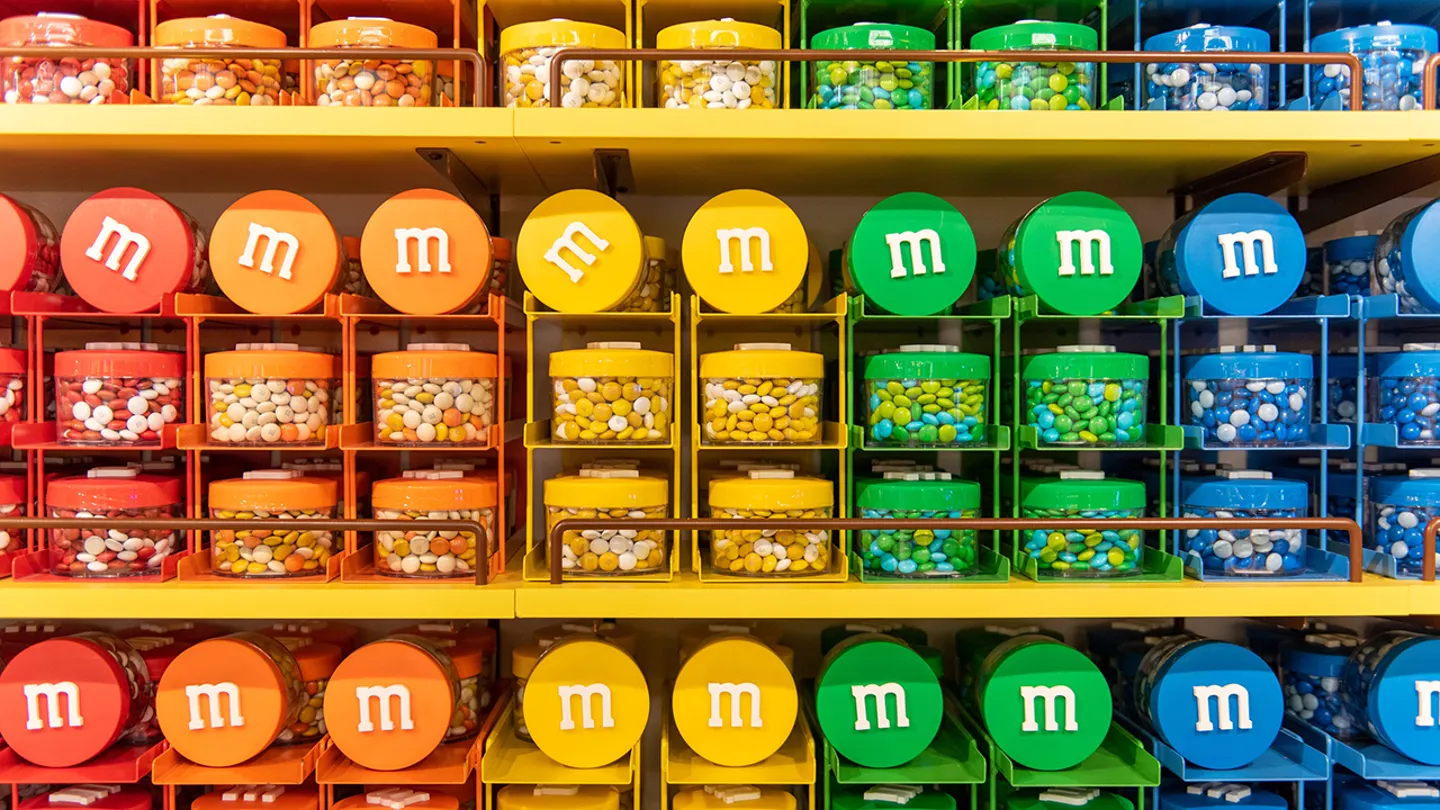
Most of us know M&M’s as a quick snack, bright candies that fit in the palm of your hand. Yes, M&M’s may be small, but the brand has created some of the largest and most ambitious retail spaces in the world. Their seven official M&M’s World stores are not just shops; they’re immersive brand experiences built on design, architecture, and storytelling.
Each flagship is a study in how space can embody identity. In London, a four-story spiral staircase turns candy into theatre. In Berlin, a sleek glass facade reflects the modern edge of the city. In Shanghai, cultural motifs weave global branding into a distinctly local story. These are not stores that sell candy; rather, they are spaces that prove how design can transform even the simplest product into an attraction worth travelling for.
Let’s take a trip around the world to explore the best M&M stores and see how each one narrates its story through design.
M&M’s World London: The World’s Largest Candy Playground

The London M&M’s store is often seen as the gold standard for experiential retail. Set right in Leicester Square, famous for its theatres, bright lights, and buzzing crowds, it doesn’t act like just another shop. Instead, it slips effortlessly into the city’s entertainment scene, feeling more like an attraction than a store.
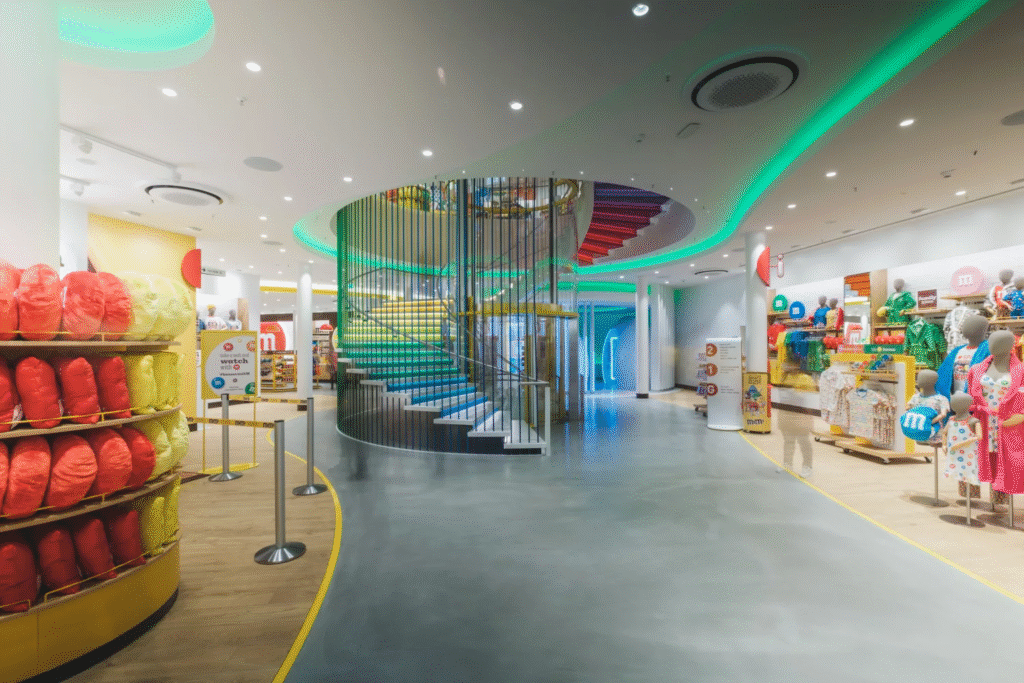
Spanning 35,000 square feet, M&M’s World London is the largest candy store on earth. Its design avoids typical retail segmentation, instead utilising expansive atriums to link four levels. Light, colour, and energy cascade vertically, giving the space the theatrical feel of a cultural attraction rather than a conventional shop.

The interiors treat every surface as a design opportunity. Walls are animated with saturated colour palettes that mirror the brand’s candy-coated spectrum, while oversized M&M sculptures and installations act almost like public art pieces. This playful demonstration of scale, from tiny chocolates in your palm to larger-than-life figures towering in the atrium, sparks wonder and keeps people engaged.
What distinguishes the London store apart is its clever use of context. Rather than dropping a global brand straight into the city, the design plays with local culture in witty ways. A notable example is the Abbey Road crossing, reimagined with M&M characters as the Beatles. It turns a slice of British heritage into an instantly Instagrammable moment, mixing humour, nostalgia, and cultural pride. It’s a smart design move that roots a global brand firmly in its London setting.
M&M’s World New York: Lighting Up Times Square

New York doesn’t do subtle, and neither does M&M’s Store in Times Square. Right in the middle of the neon chaos, its massive LED facade glows just as loud as the billboards around it. Once you step inside, the vibe only gets bigger, with open glassy spaces, bold lighting, and playful installations that keep nudging you upward through the floors. It feels less like a shop and more like a candy-fueled tour of Manhattan. The major highlight is its interactive stations, where you can design your own M&M’s, mixing tech with pure fun. Like the city itself, the store is brash, bright, and impossible to overlook.
M&M’s World Shanghai: A Fusion of Culture and Candy
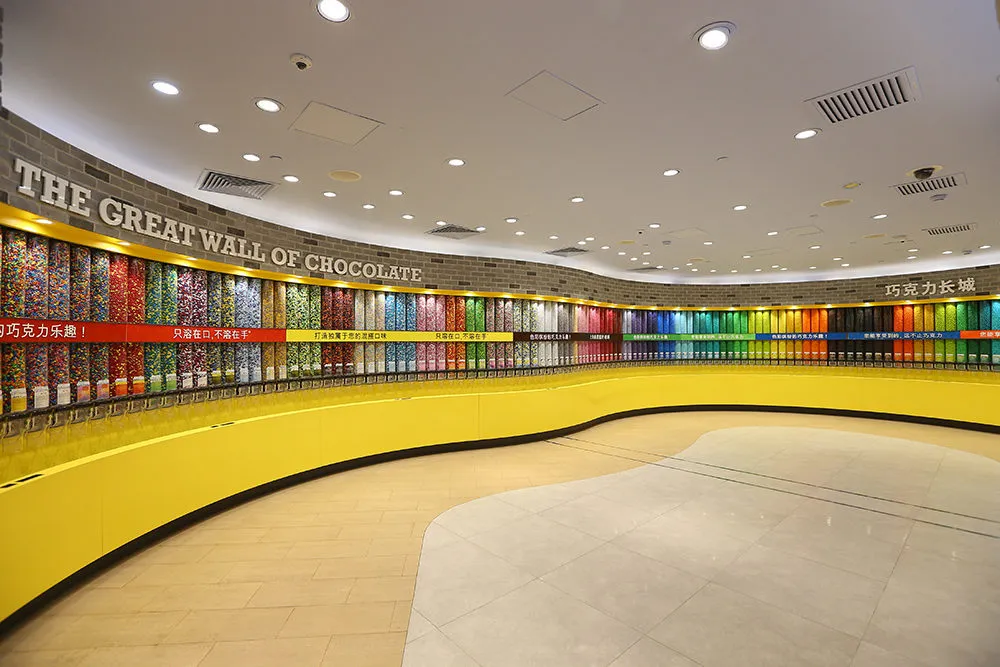
M&M’s World Shanghai redefines what a flagship store can be. Rather than simply transplanting a global brand, the design holds on to the essence of Chinese culture to create something authentic. Red and gold light up the space, colour tones that radiate energy, while clever design details tip a hat to tradition in a contemporary style. Visitors can roam through experiences that fuse the whimsical charm of M&M’s with the heartbeat of Shanghai. Every design detail is an afterthought to ground the brand in its setting, making the store feel like it belongs as much to the city as to the company. Hence, we can infer that this is cultural storytelling at its best: retail architecture that entertains, connects, and resonates far beyond its shelves of candy.
M&M’s World Las Vegas: Retail as Entertainment
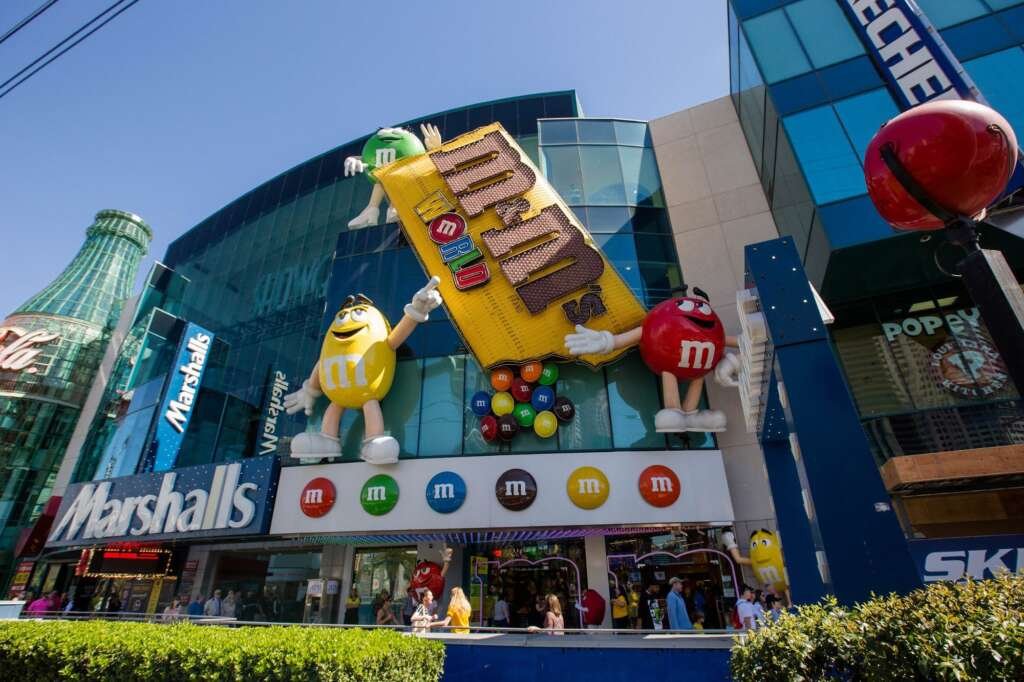
M&M’s World fits right into the Las Vegas Strip with its big, bold personality. The multi-level store feels like part attraction, part retail playground. There’s a full-size NASCAR car on display, a 3D movie to watch, and larger-than-life candy figures begging for photos. Neon lights and graphic walls pulse with the same energy as the city outside. Architecturally, the space doesn’t hold back—its vast atriums, oversized designs, and striking colours lean unapologetically into Vegas-style extravagance. It’s not just a place to buy candy, but a stage where fun, design, and entertainment collide.
M&M’s World Berlin: Sleek Modern Design with European Flair
M&M’s World Berlin offers a different kind of brand theatre, one rooted in restraint. On Kurfürstendamm, the city’s retail epicentre, the store presents a streamlined architectural presence: expansive glass, clean geometries, and subtle light. Here, minimalist interiors work like a frame for the brand’s signature colours, allowing bright reds, yellows, and blues shine without distraction. It definitely is a refreshing departure from the maximalism of London or Las Vegas, instead delivering a polished, design-led retail experience. Berlin’s store reflects the city’s design temperament, refined, adaptable, and confident, proving that retail influence often comes not from spectacle but from clarity and intention.
Also Read – Lesser-known Architectural Marvels in the World’s Top Cities You’ve Never Heard of!
What Makes These Stores Stand Out
Across the flagship portfolio, several design currents emerge:
Theatrical Scale – In London and Las Vegas, candy is staged like a performance. Towering volumes, dramatic focal points, and immersive layers create a sense of wonder that goes far beyond shopping.
Cultural Infusion – Shanghai and London show how local heritage can be translated into spatial identity, blending colours, patterns, and symbolic gestures that root the brand in place.
Engaged Participation – In New York and Las Vegas, digital media and tactile elements encourage active involvement. From interactive walls to customisation zones, the design is all about play and co-creation.
Narrative Layers – With tributes like the Beatles in London or NASCAR in Las Vegas, each store melds cultural storytelling into its architecture, making the space resonate on levels deeper than commerce.
Conclusion
What sets M&M’s Worlds apart is their design agility. Rather than repeating a fixed formula, every location absorbs the essence of its surroundings and fuses it flawlessly with the brand language. Some lean into spectacle, others into symbolism, but deep down to the core, all reveal the same versatility. In doing so, these spaces prove how retail design can carry global consistency while still speaking the language of place.
Join the discussion