

Share This Article
The debate around Open Kitchen vs Closed Kitchen has become one of the most common questions during home planning and renovation. As Indian homes become more compact and lifestyles become more social, the kitchen is no longer simply a room where food is prepared.
For some homeowners, an open kitchen creates the spacious, modern home they have always imagined. For others, the privacy and practicality of a closed kitchen still make far more sense.
The interesting part about Open Kitchen vs Closed Kitchen is that there is no universal winner. The right choice depends on how you cook, how large your home is, how often you entertain, and even the kind of Indian food prepared in your kitchen every day.
So before knocking down a kitchen wall because the open-plan images on Pinterest look beautiful, it is worth understanding how both layouts actually perform in everyday Indian homes.
Also read – Modern Indian Kitchen Layouts For 2026
What Is an Open Kitchen?
An open kitchen is designed without a full wall separating it from the living or dining area. The kitchen visually becomes part of the larger common space and may include an island, breakfast counter, peninsula or dining table between the two zones.
When discussing Open Kitchen vs Closed Kitchen, open kitchens usually appeal to people looking for a contemporary and spacious interior. Removing physical partitions can instantly make a smaller apartment feel larger, brighter and more connected.
This configuration has become especially popular in modern urban apartments where homeowners want the kitchen, dining area and living room to function as one continuous social space.
What Is a Closed Kitchen?
A closed kitchen is a separate room enclosed by walls and usually accessed through a door. It keeps cooking activities away from the living and dining areas and gives the kitchen its own defined identity.
In the Open Kitchen vs Closed Kitchen comparison, the biggest strength of a closed kitchen is separation. Smoke, smells, noise, utensils and the visual mess created while cooking remain largely confined to one room.
For homes where extensive cooking happens throughout the day, this separation can be extremely useful.
Open Kitchen vs Closed Kitchen for Indian Cooking
Indian cooking plays a major role in deciding between an Open Kitchen vs Closed Kitchen layout. Tempering spices, frying, pressure cooking, grilling and preparing masalas can create strong aromas, steam and airborne grease.
In an open kitchen, those aromas can easily travel into the dining and living room. Even with a powerful chimney, certain cooking smells can remain in fabrics, curtains, upholstery and soft furnishings.
A closed kitchen naturally provides another layer of protection. Closing the kitchen door while preparing food can prevent much of the smoke and aroma from spreading throughout the house.
However, this does not mean an open kitchen cannot work for Indian cooking. A good chimney, cross ventilation, large windows and careful kitchen planning can dramatically improve its performance.
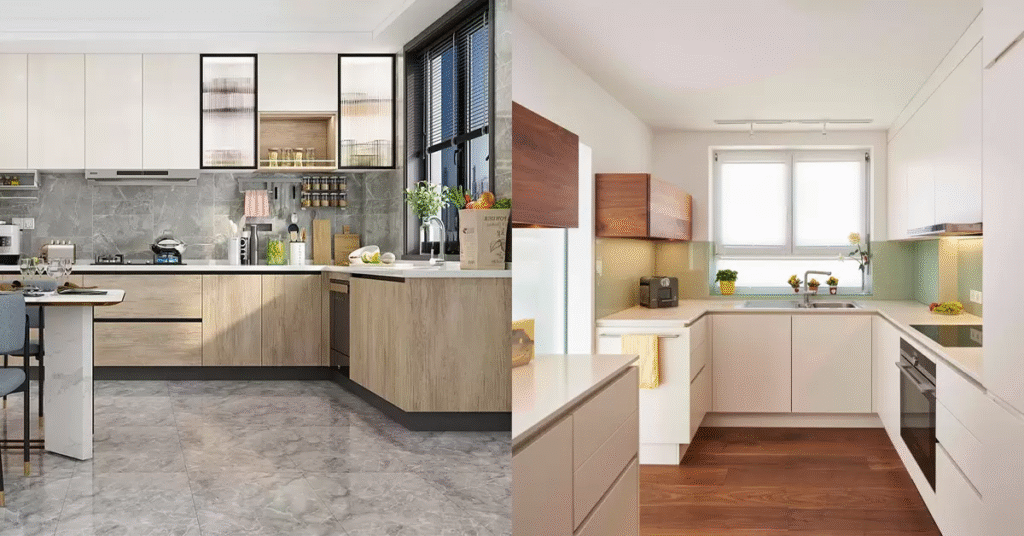
Why Open Kitchens Have Become So Popular
The popularity of open kitchens is connected to changing lifestyles. Cooking is increasingly becoming part of the social experience rather than an activity hidden behind a wall.
When comparing Open Kitchen vs Closed Kitchen, an open kitchen allows someone preparing dinner to continue talking to family members, watch television or interact with guests instead of feeling isolated.
This is particularly useful in smaller families where cooking, dining, working and entertaining often happen at the same time.
The absence of walls also creates longer sightlines. Your eye travels from the kitchen through the dining area and into the living space, making the entire home appear visually larger.
The Biggest Advantage of an Open Kitchen: Space
Space is often the deciding factor in an Open Kitchen vs Closed Kitchen discussion, particularly in compact urban apartments.
A closed kitchen requires walls, circulation space and often a dedicated doorway. Removing those divisions allows the same square footage to feel more expansive.
An open kitchen can also borrow light from the living and dining rooms. If the main living area has a large window or balcony opening, natural light can travel deeper into the kitchen.
This can make even a relatively small kitchen feel airy rather than enclosed.
Open Kitchens Make Entertaining Easier
If you regularly invite friends or family over, an open kitchen can change the experience of hosting.
Instead of disappearing into another room to prepare snacks or finish dinner, the host remains connected with the conversation. An island or breakfast counter can even become an informal gathering point.
For homeowners who enjoy entertaining, this social quality can strongly influence the Open Kitchen vs Closed Kitchen decision.
It transforms food preparation from a separate activity into part of the gathering itself.

But an Open Kitchen Puts Everything on Display
The same openness that makes the kitchen inviting also creates one of its biggest disadvantages.
Dirty dishes, cooking utensils, food preparation and clutter remain visible from the living room. If the kitchen is directly opposite the sofa or dining table, even a small amount of mess can affect the appearance of the entire common area.
When evaluating Open Kitchen vs Closed Kitchen, ask yourself how comfortable you are with maintaining a visually organised kitchen throughout the day.
For someone who prefers cleaning everything after cooking rather than during the process, an open kitchen may require a little more effort.
Closed Kitchens Give You Privacy While Cooking
Not every kitchen needs to become part of the living room.
Some homeowners prefer being able to close the kitchen door, cook without worrying about mess and clean everything once the meal is ready.
This is where the Open Kitchen vs Closed Kitchen debate becomes less about trends and more about personal habits.
A closed kitchen provides a functional workspace where cooking can remain separate from entertaining. This privacy can be particularly valuable in households where elaborate meals are prepared several times a day.
Open Kitchen vs Closed Kitchen for Small Apartments
It may seem obvious that an open kitchen is automatically better for smaller apartments, but the answer is slightly more complicated.
Removing walls can definitely make a compact home appear larger. A single kitchen-dining-living zone can create a much stronger sense of openness than three individually divided rooms.
However, storage becomes extremely important.
In a small open kitchen, every appliance, bottle and utensil can contribute to visual clutter. Well-designed cabinetry, appliance garages, tall storage units and concealed organisation become essential.
So in an Open Kitchen vs Closed Kitchen comparison for small homes, open layouts usually win visually, while closed kitchens may offer greater flexibility when it comes to everyday mess.
Closed Kitchens Can Offer More Storage
Walls are not always the enemy.
One often overlooked factor in the Open Kitchen vs Closed Kitchen discussion is vertical storage. Every wall removed from a kitchen also removes potential space for overhead cabinets, shelves and tall units.
A closed kitchen typically has more surfaces where cabinetry can be installed.
This can make a major difference in Indian homes where kitchens often need to accommodate grains, spices, cookware, pressure cookers, mixer grinders, appliances and large quantities of pantry storage.
If your household stores a lot of kitchen items, calculate your storage requirements before deciding to open the space.
What About Ventilation?
Ventilation should be one of the first considerations while evaluating Open Kitchen vs Closed Kitchen.
Indian cooking can generate heat, steam, smoke and oil particles, making a high-quality kitchen chimney extremely important.
In an open kitchen, ventilation becomes even more critical because there is no wall preventing cooking fumes from reaching nearby spaces.
Ideally, an open kitchen should include a correctly sized chimney, proper ducting and some form of natural ventilation.
A closed kitchen can contain fumes more effectively, but it still requires proper ventilation. Without it, the room can quickly become uncomfortable, hot and humid.
Noise Matters More Than You Think
Kitchen noise is rarely considered during design discussions, but it becomes noticeable once people start living in the space.
Mixer grinders, exhaust fans, pressure cookers, dishwashers and utensils can create significant sound.
When considering Open Kitchen vs Closed Kitchen, remember that an open plan allows these sounds to travel directly into the living and dining areas.
This might not matter during normal family activity. But if someone is attending an online meeting, watching television or studying nearby, kitchen noise can become distracting.
A closed kitchen provides better acoustic separation simply because there is a physical barrier between activities.
Open Kitchen vs Closed Kitchen for Families With Children
Open kitchens can be particularly attractive for families with young children.
Parents preparing meals can keep an eye on children playing or studying in the living room without constantly moving between spaces.
This visual connection can make daily routines easier and is one reason some families prefer the open side of the Open Kitchen vs Closed Kitchen debate.
However, an open layout also makes kitchen access easier.
Hot cookware, sharp objects and cooking zones therefore need to be planned carefully. Drawer locks, thoughtful appliance placement and safe counter layouts become more important in homes with toddlers.
Cleaning Requirements Can Change Your Decision
An open kitchen often demands a different level of visual maintenance because it remains visible from the main living spaces.
Countertops filled with utensils or an overflowing sink can instantly make the room feel untidy.
When comparing Open Kitchen vs Closed Kitchen, homeowners who prefer a perfectly organised home may either love an open kitchen because it encourages discipline or dislike it because everything remains exposed.
Closed kitchens provide more flexibility. You can finish cooking, shut the door and deal with the mess later.
That small advantage can feel surprisingly valuable during busy weekdays.
Can an Open Kitchen Increase Social Interaction?
One of the strongest arguments for an open kitchen is human connection.
Traditional kitchen layouts sometimes isolate the person cooking from everyone else in the home. An open kitchen removes that physical barrier.
In the Open Kitchen vs Closed Kitchen discussion, this is one feature that cannot easily be measured in square feet.
A kitchen connected to the living room encourages conversations during food preparation, casual breakfasts around an island and greater involvement from family members.
For households where the kitchen acts as the heart of daily life, that openness can completely change the atmosphere of the home.
Closed Kitchens Can Keep the Living Room Looking Calm
Modern interiors often depend on clean visual lines.
A beautifully designed open kitchen can complement this idea, but a heavily used kitchen may also introduce appliances, utensils and activity into the visual field.
A closed kitchen allows the living room to maintain its own design language without needing to coordinate every cabinet, countertop and appliance with the rest of the space.
This is an important consideration in Open Kitchen vs Closed Kitchen, particularly for homeowners who want their living room to feel calm, formal or visually minimal.
Does an Open Kitchen Cost More?
The answer depends on the design.
Removing walls may make an open kitchen sound cheaper, but creating a kitchen that looks attractive from the living room can sometimes increase the interior budget.
Cabinet finishes, hardware, lighting, countertops and appliances often need to look more refined because everything remains visible.
The Open Kitchen vs Closed Kitchen cost comparison therefore depends on priorities rather than simply construction.
A closed kitchen might require additional partitions and doors, while an open kitchen may require better cabinetry, stronger ventilation and more carefully integrated appliances.
Kitchen Islands Can Transform Open Layouts
One reason open kitchens look so appealing is the kitchen island.
An island creates additional countertop space while forming a soft boundary between the cooking area and the rest of the home.
It can function as a breakfast counter, food preparation zone, storage unit or casual workspace.
When planning Open Kitchen vs Closed Kitchen, however, remember that islands require adequate circulation.
Trying to squeeze a large island into a compact kitchen can make movement uncomfortable. In smaller apartments, a peninsula or slim breakfast counter may work much better.
The Semi-Open Kitchen Could Be the Best of Both Worlds
There is another option that deserves attention in the Open Kitchen vs Closed Kitchen debate: the semi-open kitchen.
A semi-open kitchen keeps visual connectivity while introducing some form of separation.
This could include sliding glass doors, folding partitions, fluted glass panels, half walls or wide openings that can be closed when required.
During light cooking or entertaining, the kitchen stays open and connected. During heavy frying or elaborate meal preparation, the partition can be closed.
For Indian homes, this hybrid approach can be extremely practical.
Glass Partitions Are Changing Modern Indian Kitchens
Sliding glass partitions have become an increasingly attractive solution because they maintain openness without completely exposing the rest of the home to cooking fumes.
Transparent glass allows light and views to continue across the space while creating a physical barrier.
For homeowners unable to decide between Open Kitchen vs Closed Kitchen, this solution offers flexibility.
Fluted or frosted glass can provide slightly more privacy, while clear glass maintains a strong visual connection with the living and dining areas.
Open Kitchen vs Closed Kitchen for Large Homes
In larger homes, the decision often changes because space is less restrictive.
A closed kitchen can be spacious, comfortable and well connected to a dining room without feeling cramped.
Some larger homes even use two kitchen zones: a show kitchen connected to entertaining areas and a separate utility or heavy-cooking kitchen behind it.
This approach changes the Open Kitchen vs Closed Kitchen question entirely because homeowners can enjoy the appearance of an open kitchen without sacrificing the practicality of a separate cooking area.
Of course, this requires more space and a considerably larger budget.
Think About Your Daily Cooking Style
The kitchen you see in photographs and the kitchen you actually need may be very different.
Someone who cooks occasionally and prefers quick meals may find an open kitchen extremely convenient.
Someone preparing multiple Indian meals every day may appreciate the containment and storage offered by a closed kitchen.
This is why Open Kitchen vs Closed Kitchen should always begin with lifestyle rather than appearance.
Ask how often the kitchen is used, how many people cook together, what kind of food is prepared and how much storage is required.
Those answers usually reveal the right layout faster than design trends do.
Think About Your Home Before Following Trends
Open kitchens dominate social media because they photograph beautifully.
Large countertops, pendant lights and stylish islands create impressive interiors, but a successful kitchen must work after the photographs are taken.
The Open Kitchen vs Closed Kitchen decision should reflect the size of the home, ventilation conditions, furniture arrangement and the relationship between the kitchen and living area.
A layout that works perfectly in a spacious villa may not translate well into a 700-square-foot apartment.
Good interior design adapts ideas to the home rather than forcing the home to adapt to a trend.
Open Kitchen vs Closed Kitchen: Which Is Easier to Maintain?
Both layouts require regular cleaning, but the experience differs.
With an open kitchen, cleanliness affects the appearance of the entire living space. Grease accumulation, clutter and unwashed dishes become more noticeable.
A closed kitchen can hide temporary mess, but enclosed spaces may need more focused ventilation and deep cleaning because cooking residue remains concentrated within the room.
So when comparing Open Kitchen vs Closed Kitchen, the question is not necessarily which requires less cleaning.
It is whether you prefer keeping the kitchen constantly presentation-ready or having the freedom to separate it from the rest of the house.
Which Layout Adds More Style to a Home?
An open kitchen can become one of the strongest visual features of a modern home.
Cabinet colours can connect with living room furniture, countertop materials can continue into dining spaces and statement lighting can visually link different zones.
But closed kitchens also allow more creative freedom.
Because the kitchen is separated, homeowners can experiment with bold tiles, colours and materials without worrying about matching the living room.
In terms of Open Kitchen vs Closed Kitchen, style therefore depends more on execution than layout.
Either option can look contemporary when proportions, materials and lighting are handled well.
Open Kitchen vs Closed Kitchen: The Practical Verdict for Indian Homes
So, which layout actually works better?
For compact urban apartments, people who entertain often, smaller families and homeowners who prefer visually connected spaces, an open kitchen can work beautifully.
For households that cook extensively, need more storage, use strong spices regularly or prefer privacy during meal preparation, a closed kitchen can be the more practical solution.
But increasingly, the smartest answer to Open Kitchen vs Closed Kitchen may sit somewhere between the two.
A semi-open kitchen with sliding or folding partitions allows homeowners to enjoy openness when they want it and separation when they need it.
That flexibility suits the changing nature of many contemporary Indian homes.
Final Thoughts on Open Kitchen vs Closed Kitchen
Choosing between Open Kitchen vs Closed Kitchen should never be based entirely on what looks fashionable.
A kitchen is one of the most heavily used spaces in a home, which means practicality eventually matters more than a perfect photograph.
Think about your cooking habits, family size, ventilation, storage needs, cleaning routine and how you use your living spaces.
The best answer to Open Kitchen vs Closed Kitchen is the one that makes everyday life easier.
For one family, that may mean a seamless open kitchen where everyone gathers around the counter. For another, it may mean closing the kitchen door and enjoying a peaceful living room while dinner is being prepared.
And for many Indian homes, the future may belong to flexible kitchens that can do both.