


Share This Article
Hassan Fathy’s New Gourna remains one of the world’s most influential examples of vernacular architecture, proving that affordable housing can be sustainable, climate-responsive, and deeply rooted in local culture. Designed in the 1940s near Luxor, Egypt, the project challenged conventional modern construction by using traditional materials, passive cooling techniques, and community-centered planning instead of expensive industrial methods. Decades later, New Gourna continues to inspire architects and urban planners searching for housing solutions that prioritize people, place, and the environment over standardized design.
What If the Future of Housing Lies in the Past?
In an era dominated by glass towers, concrete apartments, and rapidly expanding cities, it’s easy to assume that innovation always means building with newer materials and more advanced technology.
But Hassan Fathy believed otherwise.
The celebrated Egyptian architect spent much of his career proving that centuries-old building traditions could solve many of the challenges modern cities face today. Long before sustainability became a global movement, Fathy was advocating for climate-responsive architecture, local craftsmanship, and community participation.
His most ambitious experiment was New Gourna, a village designed not simply as housing, but as a living demonstration of how architecture could improve people’s lives while respecting their environment.
Today, New Gourna is studied in architecture schools across the world not because every aspect of the project succeeded, but because it asked questions that remain remarkably relevant.
Who Was Hassan Fathy?
Often called the architect of the poor, Hassan Fathy believed good design should be accessible to everyone, not just those with large budgets.
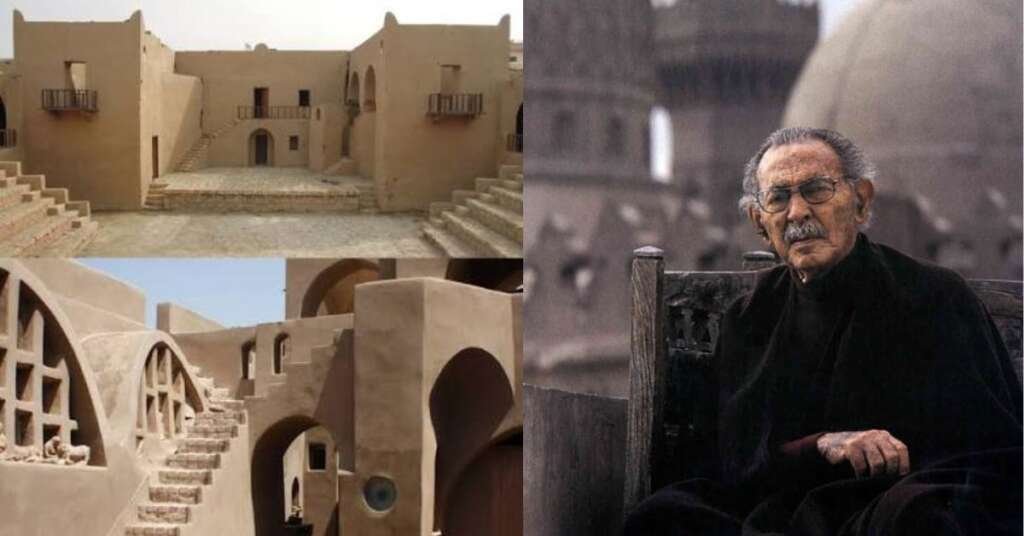
Portrait of Hassan Fathy alongside examples of his architectural work and publications.
Credits: https://www.instagram.com/p/DWgiuZvEZlH/
Unlike many architects of his time, he questioned the growing dependence on imported materials like reinforced concrete and steel.
Instead, he focused on:
- Local materials
- Traditional construction methods
- Passive environmental design
- Human-scale planning
- Community participation
His philosophy wasn’t about rejecting modernity.
It was about ensuring architecture responded to climate, culture, and the people who would ultimately inhabit it.
The Story Behind New Gourna
During the 1940s, the Egyptian government sought to relocate the residents of Old Gourna, a village situated near the archaeological treasures of Luxor.
The new settlement needed to accommodate hundreds of families while preserving social structures and supporting everyday life.
Rather than designing rows of identical houses, Hassan Fathy envisioned an entire community. New Gourna included:
- Homes
- A mosque
- A marketplace
- Public squares
- Workshops
- Schools
- Community gathering spaces
The village was planned as a complete ecosystem where architecture supported both daily routines and cultural identity.
Building With Earth Instead of Concrete
Perhaps the most distinctive feature of New Gourna was its use of mud brick.
Instead of relying on industrial materials that were costly and difficult to transport, Fathy chose adobe bricks made from the local earth.
These traditional materials offered several advantages:
- Excellent thermal insulation
- Low construction costs
- Minimal environmental impact
- Easy local availability
- Reduced embodied carbon
The thick earthen walls naturally kept interiors cool during Egypt’s scorching summers and warmer during cooler nights.
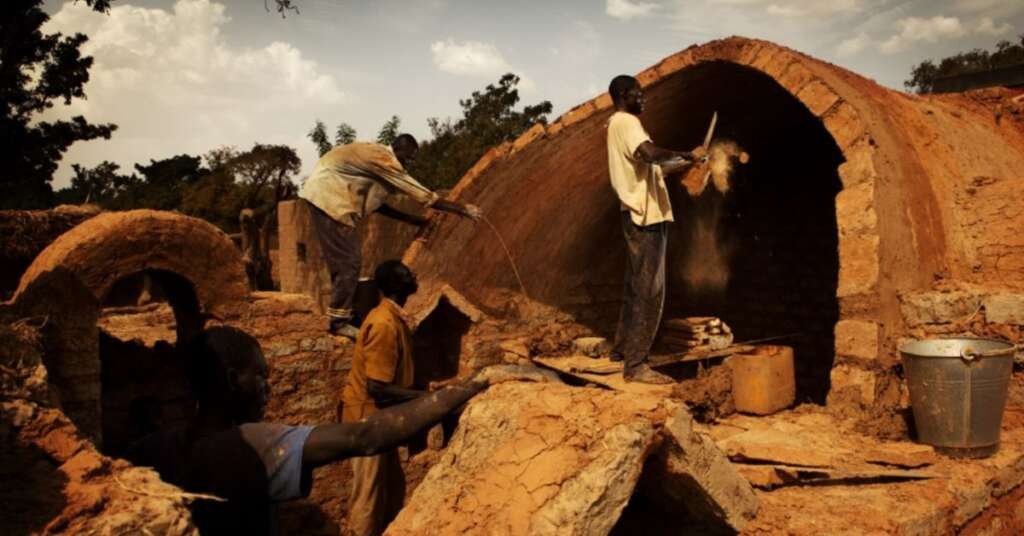
Close-up of earthen walls and mud-brick construction illustrating the sustainable material palette used in vernacular architecture.
Credits: https://eartharchitecture.org/?p=1138
Long before discussions around net-zero buildings, New Gourna demonstrated how material choice could dramatically improve environmental performance.
The Beauty of Vernacular Architecture
Vernacular architecture is often misunderstood as simply “traditional.”
In reality, it represents generations of accumulated knowledge about climate, materials, and local lifestyles.
New Gourna embraced this wisdom through elements such as:
- Courtyards
- Vaulted roofs
- Domes
- Narrow shaded streets
- Thick walls
- Wind-catching openings
These weren’t decorative features.
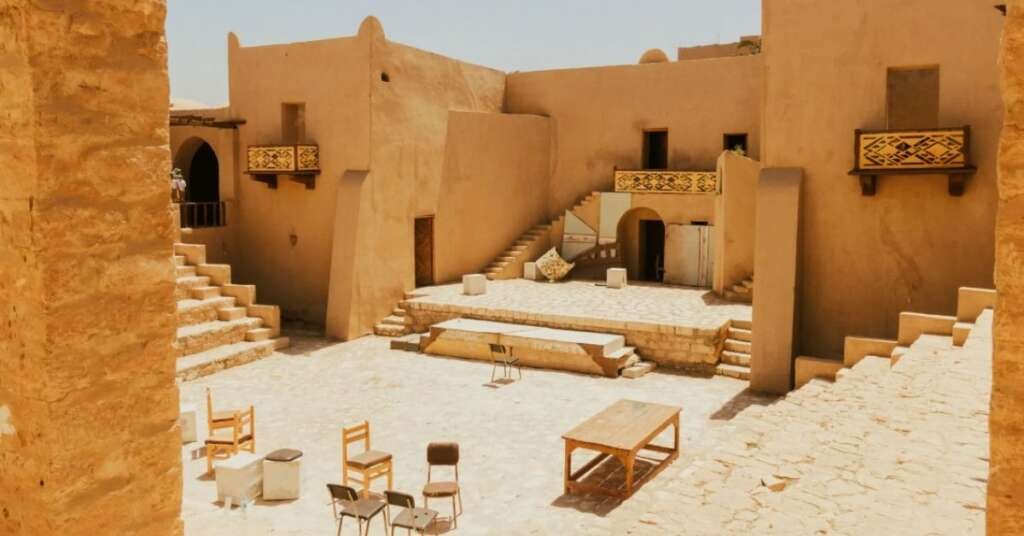
Streetscape of New Gourna highlighting adobe houses, shaded pathways, and traditional construction techniques.
Credits:
Each element performed an environmental function while contributing to the village’s architectural identity.
Passive Cooling Before Air Conditioning
One of Hassan Fathy’s greatest achievements was demonstrating that buildings could remain comfortable without mechanical cooling.
New Gourna relied on passive strategies including:
Thick Walls
Adobe walls absorbed heat slowly, reducing indoor temperature fluctuations.
Courtyards
Private courtyards encouraged airflow while creating shaded outdoor living spaces.
Vaults and Domes
Traditional vaulted roofs improved air circulation and reduced direct solar heat gain.
Street Planning
Narrow pedestrian streets provided shade for much of the day, making outdoor movement more comfortable.
Together, these strategies significantly reduced the need for artificial cooling—a lesson that remains highly relevant in today’s warming climate.
Architecture Designed Around Community
New Gourna wasn’t simply a housing project. It was a social project.
Rather than treating homes as isolated units, Fathy organized the village around shared public spaces. Residents could easily walk to:
- Markets
- Places of worship
- Schools
- Workshops
- Gathering areas
This planning encouraged interaction, strengthened community ties, and reflected the social patterns of traditional Egyptian villages.
Today, many urban planners are rediscovering these same ideas under concepts such as walkable neighborhoods and mixed-use development.
Celebrating Local Craftsmanship
Construction itself became an opportunity for community participation.
Instead of importing specialized labor, Hassan Fathy encouraged local builders to learn traditional masonry techniques.
This approach created several benefits:
- Employment opportunities
- Skill development
- Reduced construction costs
- Preservation of traditional craftsmanship
The project demonstrated that architecture could empower local communities rather than making them dependent on external resources.
Why New Gourna Faced Challenges
Despite its visionary ideas, New Gourna was not without difficulties.
Some residents initially resisted relocating from their original village.
Others preferred modern construction materials, which they associated with progress and higher social status.
Political and administrative obstacles also affected the project’s long-term implementation.
These challenges highlight an important lesson that successful housing requires more than thoughtful architecture.
It also depends on cultural acceptance, economic realities, and meaningful community engagement.
Lessons for Today’s Housing Crisis
Across the world, cities face mounting challenges:
- Rapid urbanization
- Housing shortages
- Rising construction costs
- Climate change
- Increasing energy consumption
New Gourna offers valuable lessons that remain remarkably applicable.
| Design Strategy | Modern Relevance |
| Local materials | Lower carbon footprint |
| Passive cooling | Reduced energy use |
| Courtyard planning | Improved natural ventilation |
| Community-centered layouts | Stronger social interaction |
| Traditional craftsmanship | Sustainable local economies |
| Climate-responsive design | Greater environmental resilience |
Rather than copying New Gourna directly, architects can adapt its principles to contemporary contexts.
Influence on Sustainable Architecture
Hassan Fathy’s ideas have influenced generations of architects interested in ecological and human-centered design.
His work anticipated many concepts that are now considered essential:
- Low-carbon construction
- Circular material use
- Bioclimatic architecture
- Passive design
- Community participation
- Cultural sustainability
Many contemporary architects continue to reference his work when designing affordable housing across Africa, Asia, and the Middle East.
Why Architects Still Study New Gourna
Architecture schools around the world continue to teach New Gourna because it challenges conventional definitions of progress.
The project asks timeless questions:
Can architecture reduce inequality?
Can buildings respond to climate without expensive technology?
Can traditional knowledge coexist with modern design?
Can sustainability begin with local wisdom rather than imported systems?
These questions remain as relevant today as they were eighty years ago.
The Human Side of Design
Perhaps New Gourna’s greatest contribution is its reminder that architecture is ultimately about people.
Every courtyard was designed for family life.
Every shaded street encouraged social interaction.
Every building reflected local traditions rather than international trends.
Fathy believed homes should not merely provide shelter.
They should nurture dignity, comfort, identity, and belonging.
That philosophy continues to resonate with architects seeking more meaningful approaches to housing.
What Modern Designers Can Learn
As cities become hotter and resources become scarcer, architects increasingly recognize that sustainability isn’t always about adding more technology.
Sometimes it’s about designing smarter from the beginning. New Gourna teaches us to:
- Respect climate.
- Build with locally available materials.
- Design around community.
- Learn from traditional knowledge.
- Prioritize long-term comfort over short-term aesthetics.
These principles remain powerful guides for future housing developments worldwide.
Conclusion: A Village That Changed Architectural Thinking
Hassan Fathy’s New Gourna is far more than an experimental housing project, it is a landmark in the history of sustainable architecture. By embracing vernacular design, local materials, passive cooling, and community-focused planning, Fathy demonstrated that meaningful housing does not require expensive technologies or monumental architecture. Instead, it requires a deep understanding of climate, culture, and the everyday lives of the people who inhabit these spaces.
For architects, planners, and designers, New Gourna remains a compelling reminder that some of the most innovative ideas come from reinterpreting traditional wisdom. As the world searches for more sustainable and equitable housing solutions, Hassan Fathy’s vision continues to offer lessons that are as relevant today as they were more than seventy years ago.