
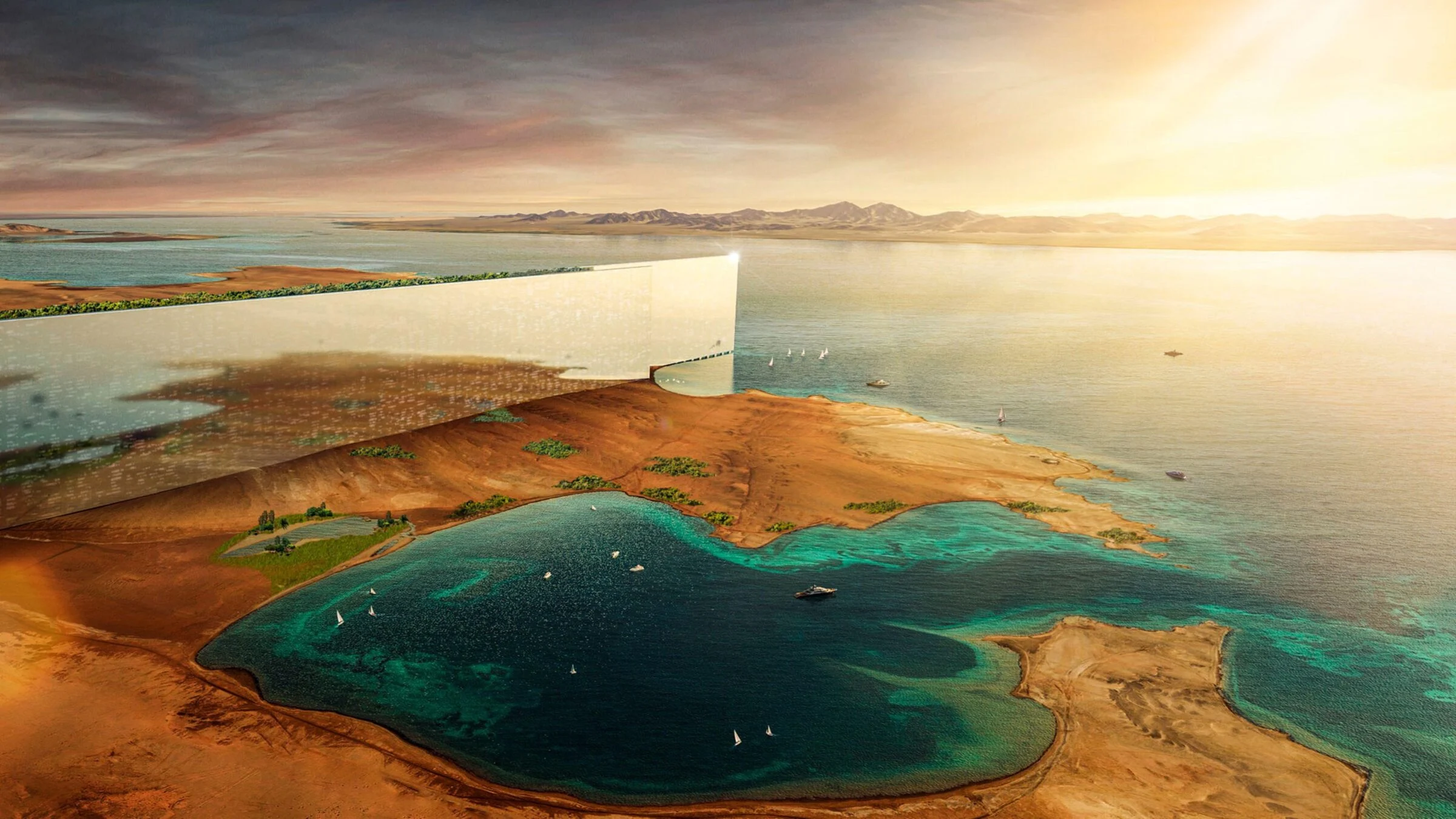
What if an entire country decided to rethink the way cities are built, buildings are experienced and people interact with their surroundings? Imagine mirrored skyscrapers rising from desert landscapes, luxury resorts blending into mountains, and traditional architecture finding a place alongside futuristic urban design.
This is the ambition behind Saudi Arabia’s Vision 2030.
Launched in 2016, the national transformation programme has introduced some of the world’s most talked-about architectural and urban development proposals. From NEOM and The Line to the Red Sea destination, Diriyah and New Murabba, Saudi Arabia is exploring new possibilities in architecture, hospitality, sustainability and interior design.
But these developments are about more than impressive skylines. They raise an important question for the global design industry: can extraordinary architectural ambition translate into practical, sustainable and meaningful places?
Quick Answer: Saudi Vision 2030 is reshaping the Kingdom’s built environment through ambitious architecture, tourism developments, cultural destinations and sustainability initiatives. However, financial pressures, construction challenges and changing project priorities mean that not every original proposal will be completed as initially announced.
Saudi Vision 2030 Is Redefining the Kingdom’s Architectural Identity
Saudi Vision 2030 is a national strategy designed to diversify the economy, strengthen tourism, attract investment and improve the quality of life across the Kingdom.
Architecture has become an important part of this transformation. New developments are intended to create destinations, encourage international investment and introduce different ways of living, working and travelling.
What makes this architectural journey particularly interesting is its diversity. Saudi Arabia is not following a single design language. Instead, its projects explore futuristic structures, traditional Arabian influences, contemporary hospitality and environmentally conscious urban planning.
The ambition behind Saudi Vision 2030 architecture is to create places that represent both the country’s cultural identity and its aspirations for the future.
For architects and interior designers, this creates an opportunity to study how large-scale development can influence urban experiences, material choices, spatial planning and the relationship between buildings and their surroundings.
NEOM and The Line Are Challenging Conventional Ideas of Urban Living
Few developments have attracted as much international attention as NEOM.
Located in northwestern Saudi Arabia, NEOM is a planned development region that includes several major destinations, including The Line, Oxagon, Trojena and Sindalah.
Among these, The Line became particularly famous for its unconventional approach to city planning.
Originally announced as a 170-kilometre linear city, The Line was designed around vertically organised communities, pedestrian accessibility, high-speed transport and reduced dependence on conventional roads.
Its proposed architectural concept challenges the traditional horizontal expansion of cities.
Instead of spreading residential, commercial and public spaces across large areas, the original design imagined communities organised within an integrated linear structure.
This approach raises several important questions:
- Can vertical urban planning create comfortable communities?
- How can residents access essential facilities without depending on cars?
- Can large developments preserve the surrounding natural environment?
- What role can technology play in improving urban life?
However, the original proposal should not be confused with the project’s current construction status. Reporting by Semafor in May 2026 indicated that further work on The Line had been delayed until after 2030, alongside significant changes to NEOM’s wider development priorities.
This is an important reminder that architectural renderings represent design ambitions, not guaranteed construction outcomes.
Nevertheless, The Line remains an interesting case study in experimental urban planning and the possibilities and limitations of futuristic architecture in Saudi Arabia.
The Red Sea Project Is Bringing Architecture Closer to Nature
Not every ambitious development in Saudi Arabia focuses on futuristic skyscrapers.
The Red Sea destination takes a different approach, placing greater emphasis on luxury hospitality, natural landscapes, marine conservation and environmentally conscious development.
Located along Saudi Arabia’s western coastline, the destination covers approximately 28,000 square kilometres and includes more than 90 islands, beaches, desert landscapes and mountain environments.
Its architectural philosophy centres on creating hospitality experiences that work with the surrounding landscape.
One particularly interesting example is Desert Rock, a resort designed around the dramatic granite mountains of the region.
Rather than treating the natural terrain as something to remove or hide, the design incorporates the surrounding rock formations into the overall guest experience.
This creates a distinctive relationship between architecture and geography.
The destination also includes projects such as Shebara Island, where contemporary hospitality architecture explores sculptural forms and a strong visual connection with the sea.
According to the official project information, 11 hotels were open at the Red Sea destination when its project profile was updated in 2026.
The development also places emphasis on renewable energy, biodiversity and regenerative tourism.
For sustainable architecture Saudi Arabia, the project offers an interesting design perspective: luxury and environmental responsibility do not necessarily have to exist in opposition.
However, long-term environmental performance will be the real test. Water consumption, energy use, construction impact and protection of marine ecosystems must be measured beyond the initial design stage.
Diriyah Is Preserving Traditional Architecture Through Contemporary Design
While futuristic developments attract attention, Saudi Arabia’s architectural transformation also involves looking back at its cultural roots.
Diriyah is an important example.
Located near Riyadh, Diriyah is closely associated with the origins of the First Saudi State. Its historic At-Turaif district is recognised for its traditional Najdi architectural character.
The architecture is known for its earth-toned mud-brick buildings, geometric detailing, compact spatial arrangements and courtyard-inspired planning.
These features were not simply decorative. They reflected local materials, climate conditions, privacy requirements and traditional ways of living.
The contemporary development of Diriyah aims to preserve this identity while introducing modern hospitality, retail, cultural and lifestyle experiences.
For interior designers, this approach offers several interesting possibilities:
- Earthy colour palettes inspired by desert landscapes.
- Textured plaster and traditional material finishes.
- Geometric patterns and handcrafted decorative elements.
- Courtyard-inspired layouts.
- Contemporary furniture combined with regional craftsmanship.
- Warm lighting that highlights architectural textures.
This is where Saudi Vision 2030 architecture becomes particularly meaningful.
Modernisation does not always require abandoning traditional design. In many cases, the strongest architectural identity comes from understanding the past and interpreting it for contemporary needs.
New Murabba and the Mukaab Introduce an Extraordinary Architectural Concept
Another ambitious development associated with Vision 2030 is New Murabba, a planned mixed-use district in Riyadh.
The project was announced in 2023 and originally presented as a 14.1-square-kilometre urban development combining residential, commercial, hospitality, entertainment and cultural spaces.
Its most recognisable proposed landmark is the Mukaab.
Designed as a monumental cube measuring approximately 400 metres in each dimension, the Mukaab was conceived as an immersive destination combining digital experiences, retail, hospitality, entertainment and technology.
Its architectural concept was inspired by modern Najdi design influences while exploring a completely different scale of interior experience.
From an interior design perspective, the proposal is fascinating.
Imagine a large enclosed environment where digital projections, lighting, interactive installations and immersive technology become part of the architecture itself.
The building was intended to offer visitors an experience that goes beyond conventional shopping or entertainment spaces.
However, its status requires an important distinction. Reuters reported in January 2026 that construction beyond excavation and piling had been suspended while financing and feasibility were reassessed. This does not mean the wider New Murabba district and the Mukaab have identical project statuses.
The development illustrates a major challenge facing large-scale architectural projects: a visually extraordinary concept must also be financially and operationally viable.
Interior Design Will Shape How People Experience These New Destinations
Architecture creates the structure of a place, but interior design determines how people experience it.
As Saudi Arabia expands its tourism, residential and entertainment sectors, the demand for thoughtful interior environments becomes increasingly important.
Hotels, restaurants, cultural centres, residential developments and public spaces all require interiors that combine functionality, comfort and visual identity.
Several design directions are particularly relevant to the Kingdom’s transformation.
1. Contemporary Arabian Interiors
Designers can reinterpret traditional Arabian aesthetics through geometric patterns, regional craftsmanship, warm colour palettes and modern furniture.
The result can be an interior that feels contemporary without losing its cultural identity.
2. Natural Materials and Textures
Stone, timber, textured plaster and earthy finishes can establish a connection between interiors and the surrounding landscape.
Material selection should also consider durability, maintenance and local climatic conditions.
3. Experiential Hospitality Design
Luxury hospitality is no longer just about attractive bedrooms and impressive lobbies.
Lighting, acoustics, circulation, privacy and shared spaces all contribute to the overall guest experience.
4. Smart and Responsive Interiors
Technology can improve comfort through intelligent lighting, automated shading, energy management and responsive environmental controls.
The most successful smart interiors will integrate technology without making everyday experiences unnecessarily complicated.
5. Cultural Storytelling Through Design
Artwork, local materials, traditional craftsmanship and carefully considered spatial details can help interiors communicate the identity of a destination.
These approaches show why futuristic architecture in Saudi Arabia should be understood through both exterior architecture and the spaces people actually occupy.
A striking building may attract visitors, but a well-designed interior helps them remember the experience.
Sustainability Must Be Measured Beyond Architectural Renderings
Sustainability is a major theme across many Saudi development proposals. But using sustainable materials or adding green spaces does not automatically make a building environmentally responsible.
The Kingdom faces specific environmental challenges, including extreme temperatures, water scarcity, intense sunlight and significant cooling requirements.
These conditions make climate-responsive design particularly important.
Some practical architectural strategies include:
- External shading systems to reduce direct solar exposure.
- High-performance glazing and insulated building envelopes.
- Energy-efficient cooling and ventilation.
- Water-efficient landscaping.
- Renewable energy integration.
- Durable materials with lower environmental impact.
- Protection of existing natural habitats.
The future of sustainable architecture Saudi Arabia will depend on how effectively these principles are implemented in completed and occupied buildings.
Design teams should also consider the full life cycle of a project, including construction materials, maintenance, energy consumption, water use and eventual renovation.
A building should not be considered sustainable simply because its original concept includes environmental features. Its actual performance matters far more.
Tourism Growth Is Creating New Opportunities for Architecture and Design
Tourism is one of the important areas being developed under Vision 2030.
According to the Saudi Vision 2030 Annual Report 2025, the Kingdom recorded approximately 123 million tourists during 2025, including domestic and international visitors. Tourism spending reached approximately $81 billion.
The report also highlighted a new ambition of attracting 150 million visitors by 2030.
These figures help explain why architecture and hospitality design have become important parts of the Kingdom’s development strategy.
As destinations expand, there is growing demand for:
- Hotels and luxury resorts.
- Cultural and heritage attractions.
- Restaurants and entertainment venues.
- Residential communities.
- Public spaces and visitor facilities.
- Airports and supporting infrastructure.
Each of these developments requires architects, interior designers, landscape architects, lighting specialists and material consultants.
This creates opportunities not only for large international design firms but also for specialists working in sustainable materials, hospitality interiors, urban planning and construction technology.
Can Saudi Arabia Complete Its Architectural Ambitions by 2030?
This is perhaps the most important question surrounding the entire transformation.
Saudi Arabia has made significant progress in developing tourism infrastructure, opening new destinations and attracting international attention.
However, some of its most ambitious megaprojects have encountered financial, construction and feasibility challenges.
The original plans for The Line have been revised, while the Mukaab’s construction has faced a reported suspension beyond early groundwork.
These developments highlight an important distinction between the broader national Vision 2030 programme and the individual projects announced under it.
A national strategy can continue to make progress even when particular developments are delayed, redesigned, scaled down or cancelled.
Large-scale projects involve considerable investment, specialist construction capabilities, infrastructure requirements, environmental assessments and long-term operating costs.
The real measure of success should therefore extend beyond the number of announced developments.
It should include:
- The quality of completed architecture.
- The usefulness of spaces for residents and visitors.
- Long-term environmental performance.
- Financial and operational sustainability.
- Preservation of cultural identity.
- The economic and social value created for local communities.
For the global design industry, these considerations are just as important as the original architectural concepts.
The Future of Saudi Architecture Will Depend on Ambition and Practical Design
Saudi Arabia’s transformation offers an important opportunity to examine how architecture can influence the future of cities.
Its developments bring together several major design conversations: futuristic urban planning, luxury hospitality, cultural preservation, technology and sustainability.
Some proposals may evolve considerably before completion. Others may become influential examples of contemporary architecture and destination design.
The most valuable lesson is that successful architecture requires more than a remarkable visual concept.
It needs thoughtful planning, appropriate materials, environmental responsibility, financial feasibility and a clear understanding of how people will use the space.
For architects and interior designers, Saudi Arabia megaprojects offer a fascinating opportunity to study both the possibilities and limitations of ambitious development.
Final Thoughts: An Odyssey of Wonders or a Work in Progress?
Will Saudi Arabia’s Vision 2030 become an odyssey of wonders?
The Kingdom has certainly introduced some extraordinary architectural ideas. From experimental urban concepts and mountain-integrated resorts to heritage-led destinations and immersive interior environments, its ambitions have challenged conventional thinking about the built environment.
But the true achievement will not be determined by architectural renderings or grand announcements.
It will depend on what is actually built, how people experience these places, how responsibly resources are used and whether the developments create lasting value.
For the global architecture and interior design community, Saudi Arabia’s journey is worth watching not simply for its scale, but for the design questions it raises.
At Smart POV, we believe great architecture is not just about creating something extraordinary to look at. It is about creating something meaningful to experience.
Join the discussion