

Share This Article
Biophilic Interior Design is often reduced to a familiar visual formula: add indoor plants, use green accents and introduce a few natural textures. But genuine Biophilic Interior Design goes much further. It is not simply about decorating a room with nature. It is about shaping an interior so that light, air, material, views, texture, movement and spatial experience create a stronger connection with the natural world.
This distinction matters because plants are only one layer of Biophilic Interior Design. A room can contain dozens of plants and still feel artificial, sealed and disconnected from its surroundings. At the same time, a space with very little visible greenery can feel deeply connected to nature when daylight shifts through the day, natural materials reveal their grain, windows frame the sky and the layout gives people both openness and shelter.
The most convincing Biophilic Interior Design therefore begins with a more useful question: how does nature actually enter the experience of a space?
Biophilic Interior Design Is About Experience, Not Decoration
The popularity of indoor greenery has made biophilia easy to recognise, but also easy to misunderstand. Biophilic Interior Design is not a visual style in the same way that minimalism, Art Deco or industrial design can be read through a set of aesthetic cues. It is better understood as an approach that strengthens the relationship between people, interiors and natural systems.
That means Biophilic Interior Design can look completely different from project to project. A coastal home may respond to sea breeze, glare, horizon and salt-washed materials. An urban office may rely on timber, daylight, sky views and quiet refuge spaces. A restaurant may use stone, shadow, flowing circulation and sound.
Contemporary biophilic frameworks also extend well beyond vegetation. They include daylight, airflow, water, natural materials, biomorphic forms, sensory variation and spatial conditions such as prospect and refuge. Biophilic Interior Design works best when nature becomes part of the experience rather than an accessory added at the end.
Do check out – Vertical Gardens and Urban Green Spaces: Reimagining City Skyscapes
Natural Light Is a Core Material in Biophilic Interior Design
One of the simplest ways nature enters an interior is through daylight. Yet daylight in Biophilic Interior Design is not only about making a room brighter. Natural light moves, changes colour, creates shadow, reveals texture and responds to weather. It quietly tells us whether it is morning, afternoon or approaching evening.
Good Biophilic Interior Design allows some of this variation to remain visible. Windows, skylights, courtyards, screens, perforated surfaces, deep reveals and translucent materials can all create changing layers of brightness and shade.
A moving patch of sun across a wall can create a stronger sense of natural rhythm than a decorative leaf motif. Filtered light through timber screens or jaalis can make interiors feel alive because the room changes over time. This is where Biophilic Interior Design becomes dynamic rather than static.
Artificial lighting can support the same idea after sunset. Layered light, warmer pools of illumination and gentle contrast often feel more natural than completely uniform brightness. Daylight and access to exterior views are also recognised within contemporary wellness-focused building standards as important components of indoor environmental experience.
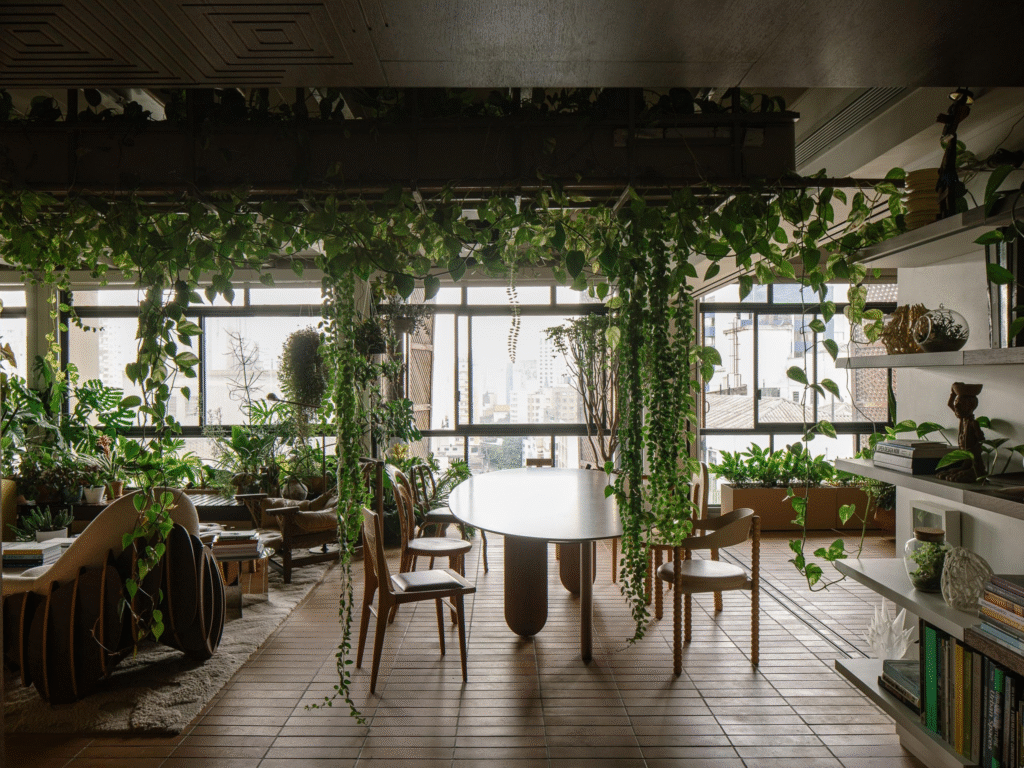
Views Can Do More Than Another Row of Plants
A window does not automatically create Biophilic Interior Design. What matters is what the opening allows people to see and how the view is composed. Sky, tree canopies, water, distant landscape, weather and even a small courtyard can create a meaningful visual relationship with nature.
In dense cities, this becomes an exercise in framing. A window can be positioned toward a tree rather than a service lane. A clerestory can reveal changing sky conditions. A balcony can extend the visual field. A reflective surface can amplify an existing landscape view.
Furniture planning matters just as much. If the best view is blocked by storage or placed behind the occupant, the opportunity is lost. Biophilic Interior Design considers where people sit, work, eat, pause and look.
The landscape does not have to be spectacular. Even a carefully framed piece of sky, moving tree canopy or courtyard can create a connection that makes an interior feel less isolated from its surroundings.
Natural Materials Give Biophilic Interior Design Depth
Wood, stone, clay, cork, linen, cane, bamboo and other naturally derived materials are closely associated with Biophilic Interior Design. Their value, however, is not simply that they create an earthy colour palette. Their real strength lies in variation, tactility and a visible connection to natural processes.
Timber grain changes from one board to another. Stone contains veins and irregularities. Clay carries subtle imperfections. Woven fibres show texture. These qualities give Biophilic Interior Design a richness that perfectly uniform finishes can often struggle to reproduce.
The goal is not to fill a room with every natural material available. Thoughtful Biophilic Interior Design uses materials that make sense for the climate, culture and function of the project. A locally familiar stone or craft technique may create a stronger sense of place than an imported finish chosen only because it looks organic.
Materials that age gracefully can deepen this connection further. Patina, soft fading and changing texture allow the interior to register time rather than pretending to remain permanently untouched.
Airflow Makes Biophilic Interior Design Something You Can Feel
Air is invisible, which is why it is often ignored in conversations about Biophilic Interior Design. Yet a slight breeze, a cooler zone beside an opening or a subtle shift in air movement can make a room feel remarkably alive.
Where climate and building conditions allow, operable windows, cross-ventilation, shaded openings, courtyards and transitional spaces can introduce this variation. Biophilic Interior Design does not require sacrificing comfort. It simply recognises that comfort does not always mean making every square metre feel exactly the same.
A balcony door opened during pleasant weather or a window seat that catches a breeze creates a direct sensory relationship with the outdoors. This type of Biophilic Interior Design is experienced on the skin, not just through the eyes.
Even in mechanically conditioned buildings, designers can think about how air, temperature and movement are perceived so that the interior does not feel completely sealed from its surroundings. Thermal and airflow variability are, in fact, recognised as distinct patterns within established biophilic-design frameworks.
Water Adds Movement, Reflection and Sound
Water can be a powerful component of Biophilic Interior Design because it engages several senses at once. It may be visible, audible, reflective and sometimes tactile. A courtyard pool can bounce changing light onto walls. A small fountain can soften background noise. A narrow water channel can guide movement through a lobby or landscape-connected interior.
Restraint is essential. A poorly considered water feature can become noisy, visually excessive or difficult to maintain. Good Biophilic Interior Design uses water only when it contributes to the atmosphere and spatial experience.
Where actual water is impractical, designers can still work with some of its qualities. Reflective surfaces, translucent materials, fluid forms and moving patterns of light can suggest softness and change without becoming literal.
The aim is not to imitate a river inside a building. It is to introduce qualities of movement, reflection and sensory variation that make Biophilic Interior Design feel more responsive.

Organic Forms Should Suggest Nature, Not Copy It
Biophilic Interior Design often borrows shapes and patterns that appear in natural systems. Curves, branching geometries, cellular structures, spirals, waves and irregular repetition can all reduce the sense of rigid artificiality.
But successful Biophilic Interior Design does not require leaf graphics on every surface. The more sophisticated approach is often abstraction. A staircase may curve like a path without pretending to be a vine. A ceiling may use branching geometry without becoming a literal tree canopy. A screen may take inspiration from cellular growth while remaining distinctly architectural.
These biomorphic references help Biophilic Interior Design feel integrated into the spatial language of the project rather than applied as themed decoration.
The goal is not to make an interior look like a forest. It is to use rhythm, variation and organic order in ways that feel familiar without becoming obvious.
Texture Makes Biophilic Interior Design More Sensory
Many interiors are designed primarily for the eye, while nature is experienced through the entire body. Texture therefore has a major role in Biophilic Interior Design.
A rough stone wall, cool floor, timber handrail, woven surface or soft natural fabric gives the body tactile information. The environment becomes more layered as people move through it. Biophilic Interior Design gains depth when surfaces are not only seen but felt.
Sound and scent matter as well. Timber, textiles and softer finishes can reduce harsh reflections, while rain, moving air, natural timber or herbs can add subtle sensory cues when they arise naturally from the place.
This multi-sensory quality is what separates a genuinely nature-connected space from an interior that simply uses botanical imagery.
Prospect and Refuge Shape Comfort Without Using Plants
Some of the most interesting ideas in Biophilic Interior Design are spatial rather than decorative. People often enjoy spaces where they can see outward while still feeling protected.
This relationship is commonly discussed through prospect and refuge. Prospect offers a longer view and a sense of openness. Refuge creates a more sheltered condition for retreat. Biophilic Interior Design can combine both in a single experience.
A window seat inside a deep reveal is a simple example: the body feels enclosed while the view opens outward. The same logic can shape restaurant booths, reading corners and workspaces.
This balance helps explain why completely open interiors can sometimes feel exposed, while overly enclosed spaces can feel restrictive. Biophilic Interior Design introduces choices between openness and shelter, creating a more varied and human spatial experience.
It also proves why biophilia cannot be understood through plants alone. Sometimes the connection to nature comes from how a room makes the body feel within space.
Nature Enters Through Time and Seasonal Change
One of the least discussed parts of Biophilic Interior Design is time. Nature is never completely static, and interiors that reveal change can feel more connected to the world outside.
Sunlight enters from different angles across the year. Trees change colour or density. Rain alters sound and reflection. Natural materials weather and develop patina. Shadows lengthen, shift and disappear. Biophilic Interior Design can make these changes visible instead of designing them out.
In homes and workplaces occupied repeatedly, movable screens, courtyards, framed weather views and responsive shading can help Biophilic Interior Design register passing time. The room becomes part of a larger environmental cycle instead of feeling sealed away from it.
An interior does not have to physically change every day. It simply needs to leave enough room for daylight, weather, material and landscape to change around it.
Why Plants Alone Cannot Create Biophilic Interior Design
Plants absolutely have a place in Biophilic Interior Design. They add life, texture, colour and visible growth. But they should not be expected to carry the entire concept.
A room filled with plants but deprived of daylight, natural materiality, fresh air and meaningful views may still feel disconnected. Poorly maintained greenery can also make Biophilic Interior Design feel more like styling than spatial thinking.
The stronger approach is integration. A tree placed beneath a skylight, herbs beside a sunny kitchen window or planting around a naturally ventilated courtyard feel connected to how the building works.
This is the difference between using greenery as decoration and using living systems as part of Biophilic Interior Design. Plants become one element in a larger network of light, air, material, view, sound and space.
Indoor planting therefore works best when it reinforces a broader architectural idea instead of becoming the idea itself.
Biophilic Interior Design Should Respond to Place
There is no universal formula for Biophilic Interior Design. A successful strategy depends on climate, orientation, available views, building type, cultural context, maintenance capacity and the way people use the interior.
In an apartment, Biophilic Interior Design may focus on daylight, balcony connections, cross-ventilation, timber and framed views. In an office, it may involve access to windows, varied work settings, natural materials and quieter refuge zones. In hospitality, Biophilic Interior Design may become more immersive through water, shadow, texture and landscape.
The strongest projects do not apply a checklist mechanically. They identify the natural qualities already available to the site and amplify them.
That is also what prevents Biophilic Interior Design from becoming a passing aesthetic trend. When the design grows from climate, landscape and human experience, it feels specific, grounded and harder to imitate superficially.
A project in Mumbai should not necessarily express nature in the same way as one in Copenhagen, Jaipur or Bali. The environment itself should help determine the design response.
The Future of Biophilic Interior Design Is More Architectural
As interest in nature-connected spaces grows, Biophilic Interior Design has the opportunity to move beyond visibly green interiors and become more closely tied to how spaces are planned and experienced.
The shift becomes apparent when daylight, courtyards, ventilation, tactile materials, changing shadows and landscape views are considered from the beginning rather than added during the styling stage. Biophilic Interior Design becomes more meaningful when architects and interior designers treat it as part of orientation, planning, material selection and sensory experience.
Sometimes the most powerful Biophilic Interior Design is almost invisible. It can be a breeze across the skin, a shifting shadow, the sound of rain, the grain of timber or a protected seat beside a distant view.
That subtlety is exactly what makes it feel real.
Instead of asking how an interior can look more natural, designers are beginning to ask how it can behave more like a space connected to nature. That change in thinking gives Biophilic Interior Design much greater architectural depth.
Biophilic Interior Design Lets Nature Enter the Everyday
The most effective Biophilic Interior Design does not ask, “How many plants can fit in this room?” It asks, “How can this interior help people experience more of the natural world?”
The answer may come through daylight, air, water, texture, views, materials, sound, seasonal change, spatial variety or organic form. Plants can be part of that answer, but they are not the whole answer.
When Biophilic Interior Design is approached this way, nature stops being decoration and becomes part of everyday architecture. The interior feels richer and more responsive because it creates space for natural experiences to enter.
That is where Biophilic Interior Design becomes more than a visual trend. It becomes a thoughtful way of shaping spaces that remain connected to the world beyond their walls.