

Share This Article
Interior design depends on more than selecting attractive furniture, colours and decorative objects. The way these elements are grouped, spaced and visually balanced has an equally important influence on how a room is perceived. One simple styling technique used to create more considered arrangements is known as the 3-5-7 rule in interior design.
The 3-5-7 rule is a decorating guideline based on grouping decorative elements in odd numbers, particularly groups of three, five or seven. Rather than arranging accessories in perfectly matched pairs or evenly divided sets, the method introduces controlled asymmetry and encourages a composition with varied heights, shapes, materials and visual weights.
The concept is closely related to the better-known rule of three in interior design, a long-established styling technique used for decorative objects, artwork, lighting and accessories. The 3-5-7 method extends that principle by allowing larger odd-numbered groupings when the scale of a surface or room requires more elements.
However, the 3-5-7 rule should not be understood as a rigid formula. A successful interior does not depend on having exactly three, five or seven objects in every arrangement. Scale, proportion, negative space, functionality and the overall design language of the room remain more important than the number itself.
What Does the 3-5-7 Rule in Interior Design Mean?
The 3-5-7 rule in interior design suggests arranging decorative objects in groups of three, five or seven rather than automatically relying on even-numbered groupings.
A small side table, for example, may require only three visually connected elements. A larger coffee table or mantel may accommodate five. Seven may work across a long console, shelving unit or larger decorative composition where sufficient space is available.
The purpose is not to fill every surface with accessories. Instead, the 3-5-7 decorating rule provides a simple framework for organising objects so that the arrangement has visual hierarchy and rhythm.
Professional styling advice surrounding the rule of three also emphasises that the objects should not necessarily be identical. Different heights, sizes, silhouettes and materials help individual elements remain distinct while allowing them to read as part of one composition.
This means that a vase, a stack of books and a low bowl can create a stronger group of three than three identical decorative pieces lined up at equal distances.
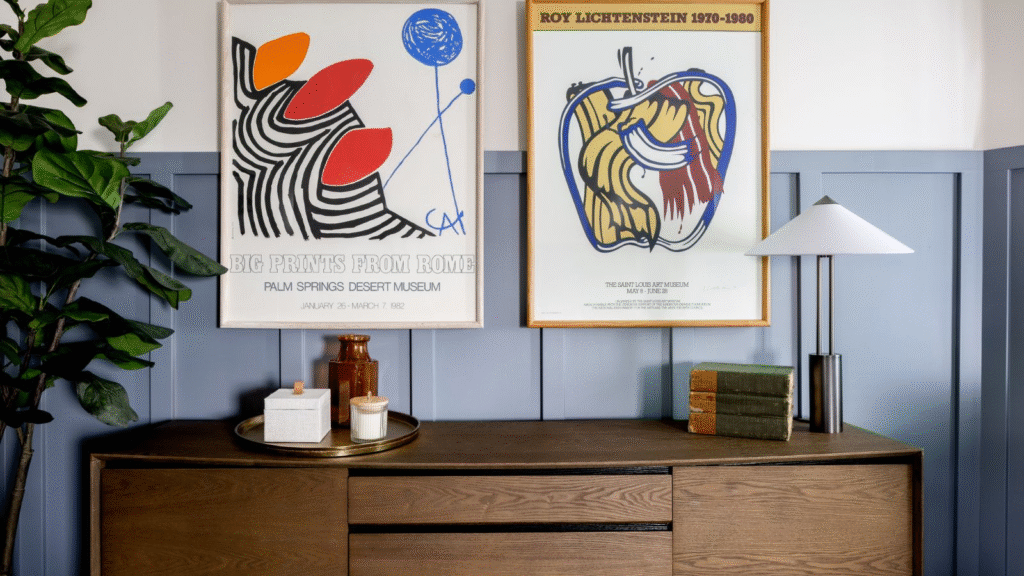
Why Odd-Numbered Groupings Are Popular in Interior Styling
Odd-number groupings are frequently used in interior styling because they provide an easy way to create asymmetrical compositions.
Symmetry divides a composition evenly and can make a room feel formal, ordered and calm. Asymmetry creates a different effect. It allows objects of different sizes and forms to balance one another without appearing perfectly mirrored.
Neither approach is inherently better.
A pair of lamps beside a bed can create excellent symmetry. Two armchairs opposite a sofa can establish a strong furniture arrangement. Matching sconces positioned on either side of a mirror can provide architectural balance.
The 3-5-7 rule becomes more useful when a designer wants an arrangement to feel less formal and more layered. Decorative shelves, coffee tables, consoles, mantelpieces and accessory displays are therefore particularly suitable places to use the technique.
The value of odd-number styling lies in flexibility rather than in the idea that odd numbers are always superior to even ones.
Also read – Interior Design in 2030: The Positive Career Outlook Students Should Know
The Rule of Three and the 3-5-7 Rule Are Closely Related
The rule of three is much more widely recognised in interior decorating than the term 3-5-7 rule.
Under the rule of three, decorative items are grouped into trios to form a single visual composition. Designers use this principle with objects such as vases, books, candles, artworks and lighting fixtures. Architectural Digest, for example, has reported designers recommending trios of accessories in varying sizes when styling bookshelves.
The 3-5-7 styling method develops the same idea for surfaces that need more visual weight.
Three objects can be sufficient for a compact table. Five can provide more opportunities for layering. Seven can help distribute visual interest across a larger surface.
The numbers should therefore be interpreted as possible scales of an odd-number composition rather than compulsory quantities.
How Groups of Three Work in Interior Design
Three is generally the simplest odd-number grouping to use.
A trio creates enough variation to establish a relationship between objects without requiring a large amount of space. This makes the rule of three suitable for side tables, nightstands, small shelves, coffee tables and compact consoles.
The strongest arrangements usually include variation.
A tall ceramic vase can establish height. A medium-sized decorative object can provide an intermediate level. A low stack of books or a shallow bowl can complete the composition closer to the surface.
The result creates a visible change in height instead of a straight horizontal line.
Colour can provide another connection between the three objects. They do not need to match, but repeating a tone, material or finish can prevent the arrangement from looking unrelated.
For example, a stone bowl, neutral books and a ceramic vase may have different shapes but share a muted material palette.
This balance between similarity and variation is more important than the number three itself.
When a Group of Five Works Better
Larger surfaces often require greater visual presence.
A long coffee table, fireplace mantel or entry console may look sparse with only three small accessories. A group of five can create a richer composition while maintaining the asymmetrical character associated with odd-number styling.
Five objects also offer more opportunities to combine vertical and horizontal elements.
A composition might include a tall lamp, framed artwork, stacked books, a bowl and a small sculptural object. Instead of spacing them evenly, several elements can be visually clustered while another creates balance on the opposite side.
The objects should still be considered according to visual weight.
A large lamp has significantly more presence than a small candle. A substantial sculpture may have more impact than several books. Therefore, five objects do not need to occupy equal amounts of space.
Interior styling is concerned with perceived balance rather than numerical equality.

How Seven Objects Can Be Used Without Creating Clutter
Seven is the most difficult part of the 3-5-7 rule to apply successfully because a larger number of accessories can quickly make a room appear crowded.
Seven objects are generally more appropriate for a generous surface, large shelving arrangement or broad decorative display than for a small table.
The objects also do not need to appear as seven separate isolated pieces.
A stack of books may visually read as a single unit. Two candlesticks of different heights can function as a small cluster. A vase and foliage can act as one focal element.
This approach allows a seven-piece composition to be organised into smaller visual relationships rather than becoming a row of unrelated accessories.
Negative space becomes particularly important as the number of objects increases. Leaving visible portions of a shelf, table or console prevents the arrangement from becoming visually heavy.
The 3-5-7 decorating rule should therefore never become an excuse to add unnecessary objects simply to achieve a particular number.
Height Is Essential to the 3-5-7 Interior Design Rule
One of the most important principles behind a successful decorative arrangement is variation in height in the 3-5-7 Rule.
Objects positioned at exactly the same level can produce a flat visual line, particularly when they are similar in shape and scale. Varying height introduces hierarchy and allows one element to become dominant while others play supporting roles.
A tall vase can function as the primary vertical element. A medium sculpture can occupy the middle of the arrangement, while a shallow tray or books create a lower layer.
The same principle can be used with five or seven objects.
Design advice around the rule of three repeatedly recommends mixing the scale and size of objects rather than using identical pieces.
Variation should remain controlled. Too many competing heights, colours, shapes and textures can create visual confusion rather than richness.
Texture Makes Odd-Number Styling More Effective
Texture adds another layer to the 3-5-7 rule in interior design.
An arrangement composed entirely of glossy ceramic objects may lack contrast even when their shapes are different. Combining stone, timber, ceramic, glass, metal, linen or natural materials can create a more layered result.
Texture is particularly useful in neutral interior design.
A beige, white or grey palette does not necessarily require strong colour contrast if the materials themselves provide enough variation. Rough stone can sit beside smooth ceramic, while natural timber can introduce warmth next to glass or metal.
The goal is not maximum variety.
A successful composition usually has enough repetition to feel coherent and enough contrast to remain visually interesting.
Scale and Proportion Matter More Than Counting Objects
The 3-5-7 rule can become ineffective when object count is treated as the main goal.
A tiny side table should not carry seven accessories simply because seven is part of the rule. Similarly, a long console may require one large statement object rather than several small decorative pieces.
Scale refers to the size of an object in relation to its surroundings, while proportion concerns the relationship between the dimensions of different elements.
Both are fundamental considerations in interior design.
A large artwork positioned above a console may already provide significant visual weight. The surface below may consequently need only a few accessories.
A wide bookshelf filled with books may require limited additional decoration because the books already form part of the visual composition.
The most successful application of the 3-5-7 styling method therefore considers the entire setting rather than treating each surface in isolation.
Using the 3-5-7 Rule for Coffee Table Styling
Coffee tables are among the most suitable surfaces for experimenting with the 3-5-7 decorating rule.
A coffee table occupies a central position in many living rooms and is visible from several directions. Its styling therefore needs to provide visual interest while preserving enough free space for everyday use.
A three-part composition might combine a stack of books, a bowl and a vase.
On a larger table, five visual elements may work more effectively. Books can create horizontal layers, while flowers or foliage introduce height. A sculptural piece can provide character, and a tray can visually organise smaller items.
Spacing is important.
Objects positioned too far apart may look disconnected, while objects placed too closely together can create clutter. They should appear visually related without occupying the entire tabletop.
Functionality should remain a priority. A successful coffee-table arrangement still leaves room for drinks, books and everyday use.
Applying the 3-5-7 Rule to Bookshelf Styling
Bookshelf styling requires a slightly different interpretation because books already contribute colour, texture, height and repetition.
Rather than placing three, five or seven objects on every shelf, the 3-5-7 rule can guide smaller compositions within the overall shelving system.
Books can be positioned vertically in one area and horizontally in another. A sculptural object can sit on a stack of books to create height. Framed photographs, ceramics and small artworks can interrupt rows of books and create focal points.
Architectural Digest’s bookshelf guidance similarly recommends varying the sizes and materials of groups rather than relying on identical decorative items.
Empty space also has an important role.
Leaving part of a shelf unoccupied can make the objects around it appear more intentional. Filling every available gap generally weakens the visual hierarchy of the display.
Does the 3-5-7 Rule Work With Cushions?
Odd-number styling can also be applied to decorative cushions, although furniture size and comfort should determine the final arrangement.
Three cushions can work effectively on a compact sofa. Five may suit a larger sofa or sectional when different sizes and shapes are layered.
The same principles of variation remain relevant.
A large plain cushion can provide a visual base, while a smaller patterned cushion adds contrast. A lumbar cushion introduces a different proportion and can prevent the composition from becoming repetitive.
However, cushion styling does not require an odd number.
Interior designers also successfully use symmetrical pairs and even-number arrangements, particularly in bedrooms and formal living spaces. Homes & Gardens, for instance, features designers using both layered groupings and simpler individual lumbar cushions depending on the desired effect.
The 3-5-7 rule should therefore support the furniture arrangement rather than dictate it.
Can the 3-5-7 Rule Be Used for Artwork?
The principle can inform artwork arrangements, although wall size, frame dimensions and architectural alignment are more important than achieving an odd number.
Three artworks can form a simple triptych or grouped composition. Five smaller frames can create an asymmetrical gallery arrangement. Seven pieces may be appropriate for a larger feature wall.
The distance between frames determines whether individual pieces are perceived as one composition or as unrelated artworks.
Alignment with surrounding furniture is also important.
Artwork above a sofa, sideboard or console should normally relate visually to the width and position of the furniture below. An odd number of frames cannot compensate for poor scale or awkward placement.
For this reason, the 3-5-7 method works best as a starting framework rather than a fixed gallery-wall formula.
The 3-5-7 Rule and Symmetry Can Exist in the Same Room
Using odd-number groupings does not mean abandoning symmetry.
Many successful interiors combine both approaches.
A bedroom may use matching bedside tables and lamps to create symmetry around the bed while displaying three decorative objects on a dresser. A living room may contain a symmetrical furniture plan but use five objects across a mantel.
This combination can produce an interior that feels structured without becoming rigid.
Symmetry is particularly useful where architecture already establishes a strong central axis, such as around a fireplace, bed, doorway or large window.
Asymmetrical accessory styling can then introduce variation within that structure.
The 3-5-7 rule is therefore not an alternative to symmetry. It is one of several composition tools available in interior design.
3-5-7 Rule vs the 60-30-10 Rule in Interior Design
The 3-5-7 rule and 60-30-10 rule are sometimes confused because both use numbers, but they address different aspects of interior design.
The 3-5-7 rule concerns the grouping of decorative elements.
The 60-30-10 rule is a colour-distribution guideline. It generally assigns approximately 60 percent of a colour scheme to a dominant colour, 30 percent to a secondary colour and 10 percent to an accent. The proportions are intended as a practical guide rather than precise measurements.
Both principles can operate within the same room.
A living room could use a dominant neutral colour, a secondary timber tone and a smaller green accent according to the 60-30-10 approach. Decorative objects containing those colours could then be arranged in groups of three or five.
The two methods solve different design problems and should not be treated as interchangeable.
When the 3-5-7 Decorating Rule Should Be Broken
No numerical styling rule should override the needs of a space.
A single oversized vase can make a stronger statement than three small decorative objects. Two matching lamps may create exactly the symmetry a room requires. Four artworks arranged in a precise grid may suit contemporary architecture better than an asymmetrical group of five.
Interior design involves relationships between scale, function, material, light, colour and architecture.
The 3-5-7 decorating rule is most useful when it simplifies a styling decision. If following the rule makes a surface look crowded, unbalanced or artificial, the rule should be ignored.
This flexibility is consistent with contemporary explanations of the method, which describe it as a styling aid rather than a strict requirement.
Common Mistakes When Applying the 3-5-7 Rule
The most common mistake is treating every individual object as equally important.
Three small candles positioned beside one large table lamp do not necessarily create a balanced four-object composition. The lamp may carry greater visual weight than all three candles combined.
Another mistake is using objects of almost identical height and size. This can result in a repetitive arrangement even when the correct odd number has been used.
Overcrowding is equally problematic.
A surface should not be filled merely to reach five or seven items. Negative space allows the arrangement to remain readable and gives the strongest objects greater presence.
Finally, the 3-5-7 rule should not be repeated visibly on every surface in the same room. Excessive use can make an interior feel formulaic rather than naturally composed.
Is the 3-5-7 Rule a Formal Interior Design Rule?
The 3-5-7 rule is better described as a decorating or styling guideline than a formal rule of interior design.
It is not a building standard, architectural regulation or measurable requirement. Nor is there a need to calculate exact quantities throughout a room.
The underlying concept is the established practice of arranging objects in odd-numbered groups, particularly the rule of three. Contemporary decorating publications and designers have expanded this idea into groups of five and seven for larger displays.
Its usefulness comes from simplicity.
The method provides an accessible starting point for understanding asymmetry, scale, rhythm, variation and visual balance. Once those principles are understood, the actual number of objects becomes far less important.
What Is the 3-5-7 Rule in Interior Design? The Final Answer
The 3-5-7 rule in interior design is a styling guideline that encourages decorative objects to be arranged in odd-numbered groups, most commonly three, five or seven.
Three works particularly well for small vignettes and compact surfaces. Five can create a more layered arrangement on medium-sized tables, shelves and consoles. Seven may suit larger displays when adequate space and visual hierarchy are maintained.
However, the success of the 3-5-7 decorating rule depends far more on scale, proportion, height, texture, spacing and negative space than on the numbers themselves.
It should be used as a flexible composition tool rather than a strict formula.
The strongest interiors balance structure with variation. Some areas may benefit from odd-number groupings, while others require symmetry, repetition or a single statement piece. When applied with this flexibility, the 3-5-7 rule can help create decorative arrangements that appear considered, balanced and visually engaging without making the overall interior feel overstyled.