

Share This Article
Why CopenHill Copenhagen Is Changing the Future of Cities
For decades, industrial infrastructure was designed to stay hidden from public life. Waste-to-energy plants, power stations, and utility buildings were often placed far from residential neighbourhoods because they were seen as purely functional spaces. CopenHill Copenhagen has completely changed that perception by proving that infrastructure can serve both the environment and the people.
Located in Copenhagen, Denmark, CopenHill, also known as Amager Bakke, is one of the world’s most innovative examples of sustainable architecture, green infrastructure, and public space design. Instead of creating another industrial building that people avoid, architects transformed a waste-to-energy plant into an exciting destination featuring a ski slope, hiking trails, climbing walls, and one of the city’s most unique recreational spaces.
CopenHill Copenhagen demonstrates how urban infrastructure, environmentally friendly architecture, and public recreation can exist together. It is not simply a power plant, it is an architectural landmark that has become a symbol of the future of sustainable cities.
What Is CopenHill Copenhagen?
CopenHill Copenhagen is a waste-to-energy power plant designed by the globally renowned architectural firm BIG (Bjarke Ingels Group). Officially opened in 2019, the project combines advanced waste management technology with innovative urban design to create a building that serves multiple purposes.
Every day, thousands of tons of waste are processed inside the facility to generate electricity and district heating for Copenhagen. Instead of hiding this industrial process behind closed walls, the architects designed the building so its roof functions as a year-round recreational park.
This combination of energy infrastructure, renewable energy solutions, urban planning, and public architecture has made CopenHill one of the most celebrated examples of modern sustainable design. It proves that essential infrastructure can also become an active part of city life.
The Vision Behind Turning Infrastructure Into Public Space
The idea behind CopenHill was simple but revolutionary. Rather than occupying valuable urban land with a building that people never interact with, why not allow citizens to enjoy it every day?
Traditional infrastructure often creates barriers between industrial zones and residential neighborhoods. CopenHill removes those barriers by inviting people onto the roof, encouraging recreation while the building continues performing its industrial function beneath.
This concept reflects a growing trend in urban regeneration, where infrastructure contributes to social life instead of interrupting it. By combining public space, green architecture, environmental engineering, and community-focused design, CopenHill creates value far beyond its primary purpose.
Sustainable Architecture Meets Advanced Waste-to-Energy Technology
At the heart of CopenHill Copenhagen is one of the world’s most efficient waste-to-energy facilities. Instead of sending municipal waste directly to landfills, the plant converts non-recyclable waste into electricity and heating for thousands of homes across Copenhagen.
The advanced filtration systems significantly reduce harmful emissions, making the facility one of the cleanest waste-to-energy plants in the world. This supports Denmark’s ambitious sustainability goals while reducing dependence on fossil fuels.
The project demonstrates how clean energy, circular economy principles, waste management, green technology, and sustainable infrastructure can work together. Rather than viewing waste as a problem, CopenHill treats it as a valuable energy resource that benefits the entire city.
Also read – The Bold Secrets Behind Centre Pompidou: Why Paris Embraced an Inside-Out Building
A Ski Slope on a Power Plant? The World’s Most Unusual Public Park
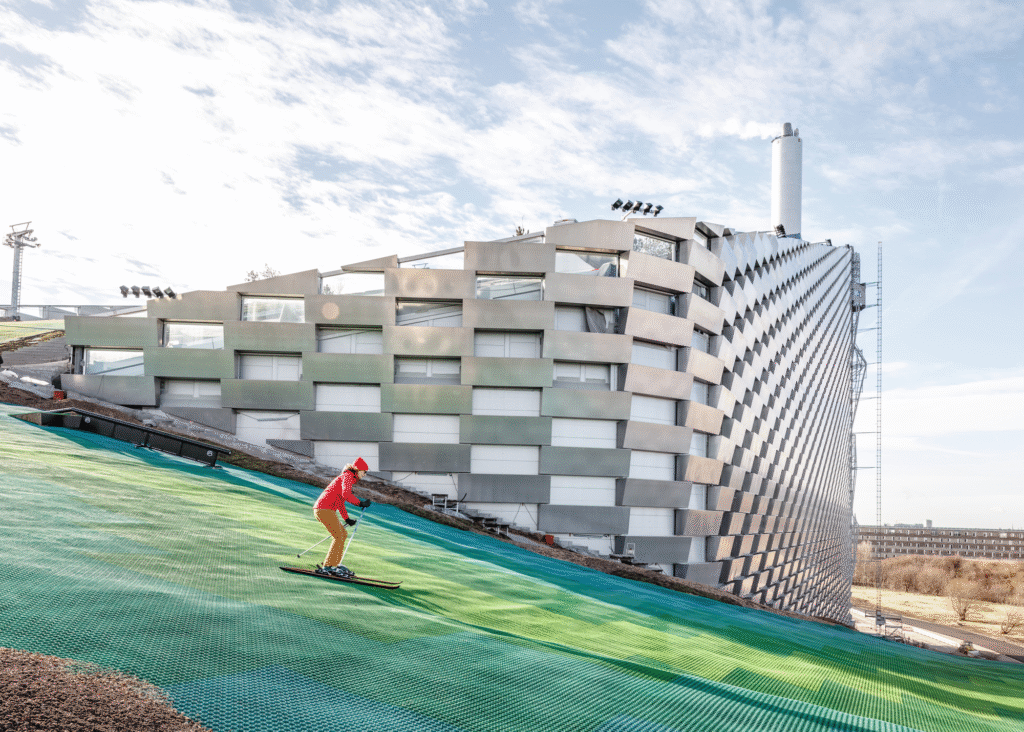
Perhaps the most famous feature of CopenHill Copenhagen is its artificial ski slope built directly on the roof of the power plant.
While skiing is generally associated with snowy mountains, Copenhagen’s relatively flat landscape inspired architects to create an entirely new recreational experience. The synthetic ski surface allows visitors to enjoy skiing throughout the year regardless of weather conditions.
Alongside the ski slope, the rooftop includes hiking trails, fitness areas, observation points, and lush landscaping. Visitors experience panoramic views of Copenhagen while standing on top of one of the city’s most important infrastructure projects.
This unique combination of urban recreation, rooftop park, public landscape architecture, and green public space has transformed CopenHill into a major tourist attraction as well as a favorite destination for local residents.

Architecture That Encourages Community Interaction
One of the biggest achievements of CopenHill Copenhagen is how it changes people’s relationship with infrastructure.
Instead of avoiding industrial buildings, residents actively visit CopenHill for exercise, outdoor activities, sightseeing, and family outings. The architecture encourages interaction, creating a stronger connection between citizens and the systems that support their everyday lives.
The climbing wall, walking paths, educational opportunities, and recreational facilities ensure that people of all ages can enjoy the building. This reflects the growing importance of human-centered architecture, where public experience becomes just as important as engineering performance.
CopenHill proves that infrastructure does not need to remain hidden behind fences. It can become an essential part of community life while still performing critical public services.
How CopenHill Supports Copenhagen’s Sustainability Goals
Copenhagen has long been recognized as one of the world’s leading sustainable cities, and CopenHill plays a major role in supporting that vision.
The facility contributes to district heating, electricity generation, improved waste management, and reduced landfill use. At the same time, its green roof and recreational spaces improve urban biodiversity while offering residents valuable outdoor experiences.
Projects like CopenHill help cities move closer to becoming carbon neutral by integrating green infrastructure, renewable energy, climate-conscious urban planning, and sustainable public architecture into everyday life.
Rather than separating environmental responsibility from urban development, CopenHill demonstrates that both goals can be achieved simultaneously.
Bjarke Ingels Group’s Innovative Design Philosophy
The architectural firm BIG, led by Danish architect Bjarke Ingels, is known for combining practicality with imagination. Their philosophy often focuses on creating buildings that solve functional problems while enriching public life.
CopenHill perfectly represents this approach. Every design decision serves both industrial efficiency and public enjoyment. Instead of sacrificing one purpose for another, the building successfully balances engineering, architecture, recreation, and sustainability.
This philosophy has influenced architects and urban planners worldwide, encouraging cities to rethink how future infrastructure projects can contribute to everyday urban experiences rather than simply occupying space.
Global Impact: Inspiring Cities Around the World
Since its completion, CopenHill Copenhagen has become an international case study in urban innovation, sustainable city planning, and adaptive infrastructure design.
Architects, engineers, urban planners, policymakers, and students regularly visit the project to understand how industrial buildings can become community assets. The success of CopenHill has encouraged discussions about transforming future power plants, water treatment facilities, transportation hubs, and other infrastructure into accessible public spaces.
As cities become denser and land becomes more valuable, multi-functional infrastructure like CopenHill offers an inspiring solution for balancing urban growth with quality of life.
Why CopenHill Represents the Future of Infrastructure
Modern cities face increasing challenges related to population growth, climate change, energy production, waste management, and limited land availability. Traditional infrastructure alone cannot solve these issues.
Projects like CopenHill demonstrate that infrastructure can perform multiple roles simultaneously. A single building can generate clean energy, manage waste, provide recreational facilities, improve urban biodiversity, attract tourism, and strengthen community engagement.
This multi-functional approach represents the future of smart cities, sustainable urban development, and innovative public architecture. Instead of separating industrial functions from everyday life, future cities may increasingly integrate them into public experiences.
Lessons Urban Designers Can Learn From CopenHill
CopenHill teaches architects and city planners that infrastructure should no longer be viewed as isolated technical systems. Instead, every major public investment presents an opportunity to create social, environmental, and recreational value.
By integrating green roofs, public parks, renewable energy systems, urban recreation, and sustainable engineering, cities can maximize the usefulness of limited urban land while improving residents’ quality of life.
The project also highlights the importance of collaboration between architects, engineers, environmental experts, and government agencies. Such partnerships make ambitious projects like CopenHill both technically successful and publicly loved.
CopenHill Copenhagen Is More Than a Power Plant
CopenHill Copenhagen has redefined what modern infrastructure can achieve. It is not just a waste-to-energy plant or an architectural landmark, it is a powerful example of how sustainable architecture, green infrastructure, public space design, and urban innovation can come together to improve everyday life.
By transforming industrial infrastructure into an engaging public destination, CopenHill demonstrates that cities no longer need to choose between functionality and beauty. They can embrace both. As more cities search for smarter ways to address environmental challenges while creating better places for people, CopenHill Copenhagen stands as an inspiring blueprint for the future of sustainable urban design and public architecture.