

Share This Article
Design Feels Softer in 2026
Design feels different in 2026.
Not colder.
Not louder.
Not harder for the sake of looking serious.
Softer.
Across architecture and interior design, there is a clear shift toward spaces that feel warmer, more tactile, more breathable, and more emotionally tuned to the people living inside them. Current architecture coverage is paying increasing attention to ideas like soft architecture, adaptive environments, circularity, biomaterials, and carbon-conscious design, while design media continues to spotlight homes that feel personal, textural, and deeply lived in rather than stiffly perfected.
This softer mood is not about making design vague or weak. It is about making it more perceptive. Spaces today are expected to do more than photograph beautifully. They have to calm the eye, hold light gently, age with dignity, and feel human in a way that many polished interiors and sharply controlled buildings no longer do. That is why soft design 2026 is becoming such a meaningful phrase. It captures a larger emotional change in taste.
What is most interesting is that this shift is happening across very different design worlds. On one side, you have Kengo Kuma, whose work has long explored lightness, material sensitivity, rhythm, porosity, and a quieter relationship between building and setting. On the other, you have Emma Chamberlain’s Los Angeles home, which became notable not because it chased polished celebrity luxury, but because it felt personal, textured, and unapologetically warm. Those worlds are different, but they meet in one shared idea: softness has become a design strength.
Why Soft Design Is Becoming the Defining Language of 2026
For years, many contemporary spaces were built around visual control. Smooth finishes. Sharp edges. Highly edited palettes. Minimalism so strict that it often stripped away comfort along with clutter. There was discipline in that language, but there was also fatigue. Too many spaces began to feel immaculate and emotionally distant at the same time.
That is why the current turn feels so significant. ArchDaily’s recent discussion of soft architecture describes a move away from the static monument and toward environments that breathe, bend, adapt, and allow transformation. Their broader architecture trend coverage also points to circularity, biomaterials, local identity, and carbon-conscious thinking as converging priorities. When those values enter architecture and interiors, the aesthetic naturally changes too. It becomes less aggressive and more grounded.
Soft design, then, is not a decorative trend layered on top of old habits. It is a deeper recalibration. It signals that designers are becoming more attentive to mood, comfort, environmental intelligence, and the lived afterlife of materials. A soft room is not merely a room in beige. A soft building is not merely one with curves. Softness appears in the way light is filtered, in the honesty of surfaces, in the absence of visual tension, and in the sense that the space has been designed for inhabitation rather than display.
This is why the word soft works so well as the central idea of the article. It travels easily between scales. It can describe architecture, interiors, materials, light, acoustics, and atmosphere all at once. In 2026, that breadth is exactly what makes it useful.
What Kengo Kuma Teaches Us About Soft Architecture
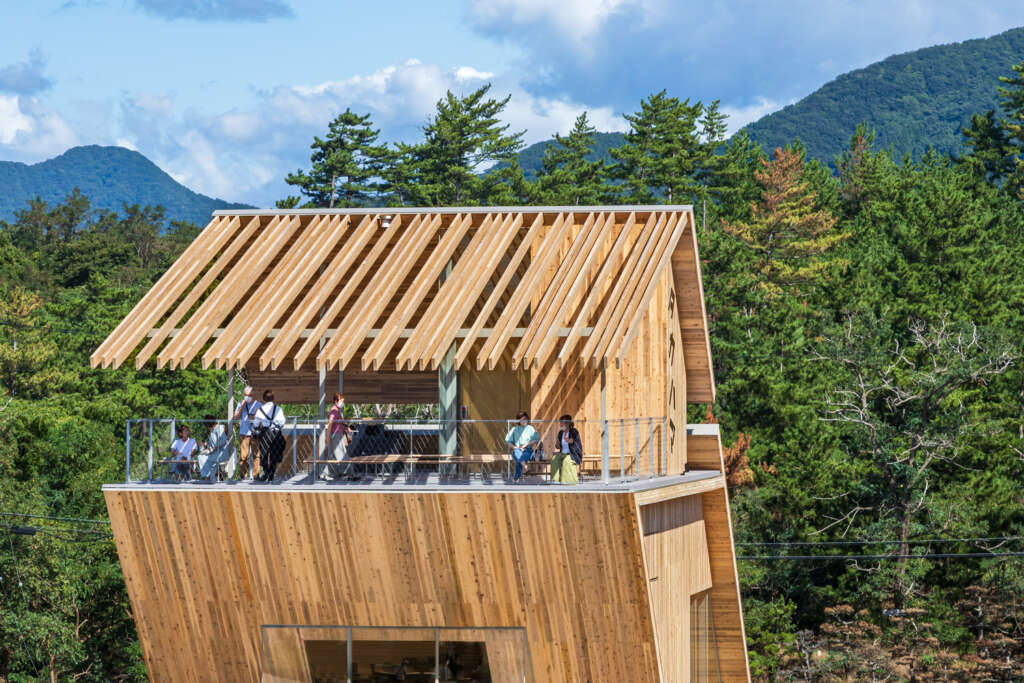
Kengo Kuma remains one of the clearest architectural references for this softer design language. In a 2025 conversation with ArchDaily, he speaks about blending materials and nature and describes the kind of architecture he tries to achieve as a rainbow. That phrasing is revealing. It tells us that his interest lies not in brute monumentality, but in the delicate space between structure, atmosphere, light, and perception. ArchDaily’s broader profile of Kuma’s work also emphasizes his fascination with rhythm, lightness, and the reinvention of natural materials.
What makes Kuma’s work so relevant to 2026 is that its softness is not cosmetic. It does not depend on surface styling. It is embedded in the logic of the architecture itself. The softness comes through layered timber, filtered daylight, visual porosity, fine-grained detailing, and a refusal to let the building overpower either the site or the body. His spaces often feel composed without feeling forceful. They hold presence, but they do not insist on domination.
As an architect, I find that especially valuable. Mature design is rarely about adding more expression. More often, it is about knowing what to reduce. It is about controlling force. It is about allowing a building to feel resolved without making it feel severe. Kuma’s design philosophy makes that lesson visible. He reminds us that architecture can be serious without becoming hard-edged, and memorable without becoming loud.
Why Emma Chamberlain’s Home Reflects the New Soft Interior Mood
Emma Chamberlain’s home matters in this discussion because it captured something the design world was already beginning to crave. Architectural Digest’s feature on the house describes a cedar-clad 1955 structure shaped with cork-lined ceilings, raw copper, honey onyx, custom plaster, vintage finds, and a mood that feels more intimate and artful than polished in a conventional luxury sense. The house was presented not as a showroom, but as a deeply personal environment built around texture, comfort, eccentricity, and memory.
That is exactly why it resonates with the softer interiors movement. The home does not feel anonymous. It does not chase the sterile perfection that has dominated too many aspirational interiors for too long. Instead, it gives value to grain, patina, handmade surfaces, collected objects, and a clear emotional point of view. It proves that a room can be sophisticated without becoming cold, and expressive without becoming chaotic.
This is one of the strongest interior design lessons of 2026. People are no longer only attracted to spaces that look expensive. They are drawn to spaces that feel emotionally legible. They want softness in the palette, softness in the lighting, softness in the upholstery, softness in the material transitions, and softness in the overall mood. Emma Chamberlain’s home did not invent that desire, but it became a vivid, widely recognized example of it.
Why People Are Drawn to Softer Spaces Right Now
There is a cultural reason this shift feels so timely. Daily life has become sharper, faster, and far more overstimulated than the spaces many people actually want to inhabit. Screens are bright. Urban noise is relentless. Digital culture rewards contrast, speed, and constant performance. In that atmosphere, a softer room feels almost medicinal.
That is why softness is no longer a stylistic extra. It is becoming a design response. A calmer space reduces visual fatigue. A warmer palette lowers tension. A material-rich room creates sensory depth that smooth, synthetic sameness often fails to deliver. A building that modulates light well does more than look elegant; it changes how the body experiences time inside it.
This helps explain why warm minimalism has more staying power now than colder forms of minimalism. It still values clarity and discipline, but it does not treat sterility as a virtue. It edits without erasing life. It leaves room for shadow, texture, and atmosphere. And perhaps most importantly, it understands that people want spaces that support them, not just impress them.
The Return of Materiality in Architecture and Interior Design

If softness has a physical language, materiality is that language.
Recent architecture coverage has leaned heavily into material intelligence, circularity, biomaterials, and carbon-conscious construction, all of which strengthen the return of tactile, honest, and locally meaningful materials. This is not only an environmental conversation. It is also an aesthetic one. When architecture starts to care more seriously about lifecycle, craft, and reuse, it almost inevitably becomes more textural and less artificially smooth.
Timber feels different from laminate. Limewash feels different from flat synthetic paint. Natural stone with visible variation feels different from engineered sameness. Linen, clay finishes, woven fiber, brushed metals, and handmade ceramics all introduce a softer sensory register into a space. They alter the way light lands. They alter the way shadow sits. They alter the way the room is remembered.
This is where architecture and interiors begin to speak the same language again. Kengo Kuma’s work shows how architecture can soften through material articulation and lightness. Emma Chamberlain’s home shows how interiors can soften through texture, personality, and organic material layering. In both cases, material is not simply a finish. It is the emotional engine of the space.
What Softer Design Looks Like in Practice
A softer design language usually reveals itself not through one dramatic gesture, but through a series of controlled, thoughtful decisions:
- natural materials such as timber, plaster, linen, clay, cork, and stone; rounded or gently eased forms; layered lighting instead of harsh brightness; earthy and muted palettes instead of extreme contrast; and interiors that feel collected and inhabited rather than over-staged.
That is the practical face of soft design 2026. It is subtle, but it is powerful.
How Soft Design Is Redefining Luxury in 2026
One of the most important things happening right now is the quiet redefinition of luxury. Older visual codes of luxury often depended on obvious perfection, oversized statements, and expensive surfaces that announced themselves immediately. The newer idea is more restrained. It values comfort, atmosphere, craftsmanship, and emotional depth over visual aggression.
This is why soft design does not reject luxury. It reframes it. A soft interior can still be deeply refined. A soft architectural language can still be highly intellectual. In fact, softness often makes sophistication more believable because it suggests confidence. The designer is no longer relying on spectacle to create impact. The room is allowed to breathe. The material is allowed to speak. The light is allowed to do part of the work.
That shift is very likely to keep growing because it aligns with larger priorities already visible in design media: sustainability, authenticity, atmosphere, and personal identity. The most memorable spaces in this mood are not the ones that try hardest to perform importance. They are the ones that feel resolved, calm, and deeply inhabitable.
What Designers and Homeowners Can Learn From This Shift
There is a practical lesson in all of this. You do not need to imitate Kengo Kuma literally. You do not need to recreate Emma Chamberlain’s interiors object for object. What matters is understanding why their spaces feel current.
They feel current because they are soft without being careless. They are expressive without being noisy. They are tactile without becoming rustic clichés. They show that warmth can be sophisticated, restraint can be sensual, and personality can coexist with formal control.
Kengo Kuma’s work has long offered an alternative to the hard-edged monumentality that defined much of late twentieth-century architecture, and that sensitivity to natural light and ventilation is one reason softer spaces feel more relevant today
For architects, that means asking different questions. Does the space soften the experience of light? Does the material palette create intimacy or distance? Does the building hold presence through calm rather than through force? For interior designers and homeowners, it means looking beyond trend-shopping and paying closer attention to mood, layering, texture, and the emotional logic of the room.
When design is approached this way, softness stops being a visual effect and becomes a discipline.
Final Thoughts: Why Softness Has Become a New Form of Sophistication
The real message of 2026 is not that design has become less ambitious. It is that ambition now wears a different face. It is quieter. More intelligent. More aware of the body, the climate, the lifespan of materials, and the emotional afterimage of a room.
Softness has become a form of authority.
That is why the pairing of Kengo Kuma and Emma Chamberlain works so well. One represents the architectural side of this shift through lightness, material sensitivity, and quiet spatial control. The other represents the domestic side through warmth, tactility, and an unapologetically personal interior language. Together, they reveal a broader truth: people want spaces that feel human again.
In a world flooded with visual noise, harder is no longer automatically better. Sometimes the most memorable space is the one that lowers its voice.
Conclusion
From Kengo Kuma to Emma Chamberlain, one thing feels unmistakable in 2026: design is moving toward softness.
Not softness as indecision.
Not softness as trend fluff.
Softness as design intelligence.
It shows up in architecture that filters rather than dominates. It shows up in interiors that comfort rather than perform. It shows up in materials that age with grace, in palettes that feel grounded, in light that arrives gently, and in spaces that understand how people actually want to live.
That is why soft design 2026 matters.
It is not just telling us what looks current. It is telling us what feels right.
And that is exactly why this softer design language may become one of the most lasting design signatures of the decade.