

Share This Article
Discover the story behind Fallingwater, Frank Lloyd Wright’s architectural masterpiece that redefined harmony between architecture and landscape. A timeless lesson in organic design.
Some buildings make headlines. A few make history. And then there are those rare ones—like Fallingwater—that change the way we see architecture itself.
When I first saw images of Fallingwater, I was struck by how the house didn’t just sit near the waterfall—it lived with it. It floated over it. It became it.
Designed in 1935 by Frank Lloyd Wright, Fallingwater is more than an architectural icon—it’s a statement of belief. A belief that buildings should grow from the earth, not be placed on it. That nature is not something to be tamed, but embraced.
Here’s the story of one of the most celebrated homes in the world—and why, almost a century later, it still matters.
Where Is Fallingwater?
Fallingwater is nestled in the Laurel Highlands of Pennsylvania, in Mill Run, about 70 miles southeast of Pittsburgh. The house is built directly over a waterfall on Bear Run, part of a forested area that was once the weekend retreat of the wealthy Kaufmann family, owners of a department store in Pittsburgh.
They had no idea that hiring Wright would result in a structure that would redefine American architecture.
The Vision: Architecture and Nature as One
When Edgar Kaufmann Sr. commissioned the house, he expected a picturesque view of the waterfall. But Wright had a different idea.
He shocked the Kaufmanns by proposing something far more radical: to build the house directly over the falls.
Wright’s goal was not just to frame nature but to immerse the inhabitants in it. The sound of the water echoes through the rooms. The rocks from the riverbed pierce the floors. Glass walls blur the boundary between inside and out.
This was not just clever design—it was organic architecture, Wright’s philosophy that buildings should reflect and respect the environments they inhabit.
How It Was Built: Defying Gravity with Innovation
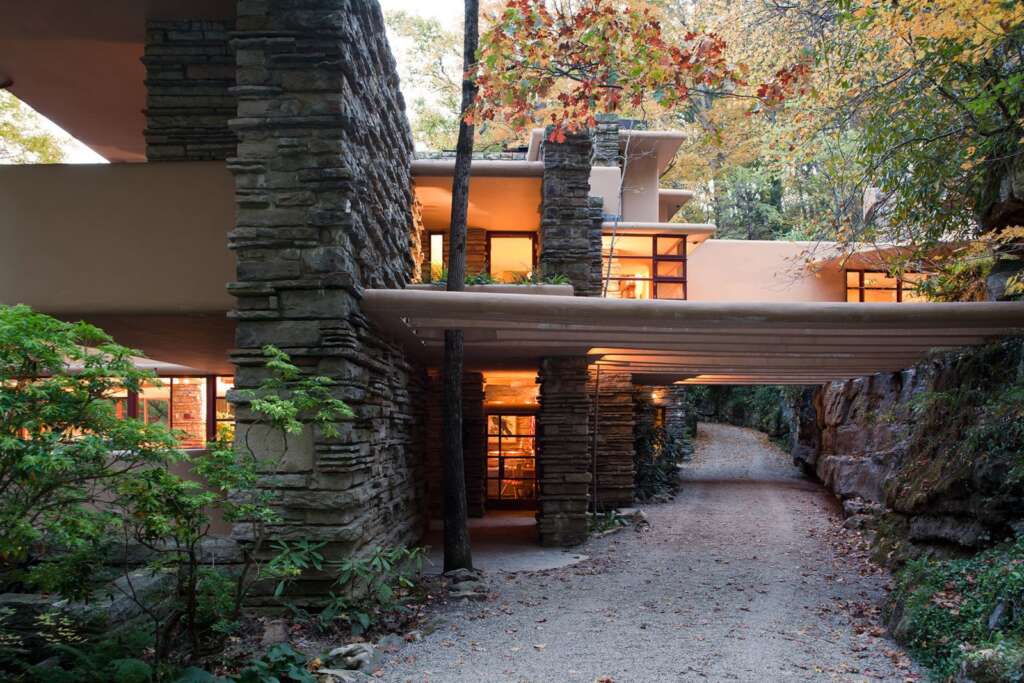
Fallingwater is known for its bold, cantilevered terraces that extend out over the water like diving boards. These floating slabs are anchored by a central stone core, made from local sandstone.
Wright used:
- Reinforced concrete for the dramatic horizontal projections
- Locally quarried stone for walls, blending into the landscape
- Steel frames and ribbon windows to allow seamless views of the woods and water
The integration was so meticulous that even the living room fireplace incorporates a boulder found on-site—Wright refused to move it.
But these bold choices came with structural challenges. Over time, the cantilevers sagged, and reinforcement was needed decades later. Still, the original vision has stood the test of time.
Inside Fallingwater: Space, Flow, and Philosophy
The interiors are just as poetic as the exterior. Every design choice was intentional:
- The low ceilings direct your gaze outward, toward the forest and falls
- Open-plan rooms create fluidity and connection
- Built-in furniture, also designed by Wright, reduces clutter and emphasizes simplicity
- Stairs from the living room descend directly to the stream, inviting interaction with nature
Even the color palette was inspired by the surroundings—ochres, earthy reds, and warm neutrals.
Wright believed architecture should evoke emotional response, not just visual awe. And that’s exactly what Fallingwater does—it feels alive.
Recognition and Legacy
Since its completion in 1937, Fallingwater has earned global acclaim:
- Declared a National Historic Landmark in 1966
- Called “the best all-time work of American architecture” by the American Institute of Architects in 1991
- Added to the UNESCO World Heritage List in 2019, alongside other Wright masterpieces
More than 5 million people have visited the site, and countless more have studied it. Fallingwater is taught in schools, drawn by students, and revered by designers as the pinnacle of site-responsive architecture.

Also Read – How to Start Designing When You Feel Stuck: 6 Strategies for Architecture Students
Why Fallingwater Still Matters
In today’s world of glass towers, urban sprawl, and climate anxiety, Fallingwater feels more relevant than ever.
It asks us:
- Can buildings be bold yet humble?
- Can design serve both people and place?
- Can we create without conquering?
Fallingwater proves that the answer is yes. It’s not just about looking good. It’s about belonging—to the land, the water, the seasons.
What Fallingwater Teaches Us
Fallingwater isn’t just a house. It’s a masterclass in vision, courage, and restraint.
Frank Lloyd Wright didn’t just design a structure—he designed an experience. A philosophy. A reminder that the most powerful architecture doesn’t dominate nature—it listens to it, echoes it, and flows with it.
If there’s one lesson I carry from Fallingwater, it’s this:
Good architecture doesn’t just shelter you—it awakens you.
Want more stories about the world’s most iconic buildings and the minds behind them? Stay tuned to SMART.POV—where we uncover the soul behind the structure.