


Share This Article
ccc is one of the most remarkable examples of how contemporary design can bridge cultures, climates and centuries of artistic heritage. Located on Saadiyat Island in Abu Dhabi, the museum is far more than a place to display art. It is an architectural experience where light becomes a building material, shadow becomes a design element, and culture becomes the foundation of every spatial decision.
Designed by Pritzker Prize-winning French architect Jean Nouvel, the Louvre Abu Dhabi opened in 2017 and quickly established itself as one of the world’s most significant cultural landmarks. Unlike many iconic museums that rely on dramatic forms alone, this project achieves its impact through atmosphere, geometry, and an extraordinary understanding of place.
What makes the building special is not simply its size or its collection. It is the feeling of walking through it.
The shifting patterns of sunlight, the cool shaded courtyards, the reflections on the water, and the interplay between traditional Arab architecture and contemporary engineering create an experience that feels both timeless and futuristic.
More Than a Museum
Many museums function as containers for art.
Louvre Abu Dhabi was designed as a destination where the architecture itself becomes part of the exhibition. Jean Nouvel envisioned the project as a “museum city” rather than a single building. Instead of creating one monumental structure, he designed a collection of galleries, courtyards, plazas and public spaces connected beneath a vast floating dome.
This approach allows visitors to experience movement, discovery and changing perspectives throughout their journey.
The architecture encourages exploration.
You don’t simply enter a museum. You wander through an environment shaped by light, water and culture.
The Dome That Changed Everything
When people think of Louvre Abu Dhabi, they immediately think of the dome.
And for good reason.
Spanning approximately 180 meters in diameter, the massive geometric dome appears to float effortlessly above the museum complex. Yet its significance goes far beyond aesthetics.
The dome acts as:
| Function | Purpose |
| Climate Moderator | Reduces heat and solar exposure |
| Shading Device | Creates comfortable outdoor spaces |
| Cultural Reference | Inspired by traditional Arabic architecture |
| Visual Landmark | Defines the museum’s identity |
| Light Filter | Produces the famous “rain of light” effect |
Constructed from multiple layers of intricate geometric patterns, the dome creates an extraordinary relationship between sunlight and shadow.
It is both engineering and poetry.
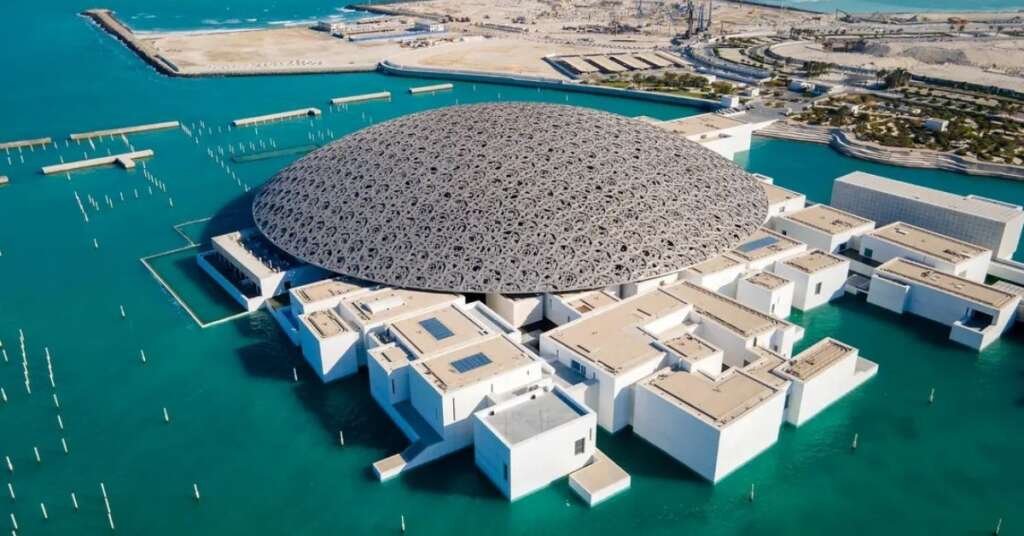
Louvre Abu Dhabi’s iconic floating dome creating intricate patterns of light and shadow over the museum complex.
The Magic of the “Rain of Light”
Perhaps the most celebrated feature of Louvre Abu Dhabi Architecture is what Jean Nouvel calls the “Rain of Light.” As sunlight passes through the dome’s layered geometric structure, thousands of beams filter through the openings.
The result is mesmerizing.
Throughout the day, light dances across pathways, walls, plazas and water surfaces. The patterns continuously shift with the movement of the sun.
No two moments feel exactly the same.
This effect was inspired by a familiar experience in traditional Arab cities, sunlight filtering through palm leaves and narrow alleyways. By translating this memory into contemporary architecture, Nouvel created a building that feels deeply connected to regional identity while remaining entirely modern.
Architecture Rooted in Culture
One reason Louvre Abu Dhabi feels so authentic is because it doesn’t impose a foreign architectural language onto its setting. Instead, the project draws inspiration from the region’s cultural and urban traditions. Visitors often notice references to:
- Traditional Arab medinas
- Narrow shaded streets
- Courtyard architecture
- Waterfront settlements
- Geometric Islamic patterns
- Passive cooling strategies
Rather than replicating historic forms directly, Jean Nouvel reinterpreted these ideas through a contemporary lens.
The result is architecture that feels both global and local. Modern yet deeply contextual.
Water as an Architectural Element
Water plays a critical role throughout the museum experience. The building appears to emerge from the sea itself.
Positioned along the waterfront, many areas of the museum are surrounded by shallow pools and reflective surfaces that blur the boundary between architecture and landscape.
The reflections amplify the visual impact of the dome while helping create a calm, meditative atmosphere.
This relationship between water and architecture serves multiple purposes. It enhances beauty. It improves comfort. And it reinforces the idea that the museum belongs to its coastal setting.
Walking through the complex often feels less like visiting a building and more like moving through a carefully choreographed environment.
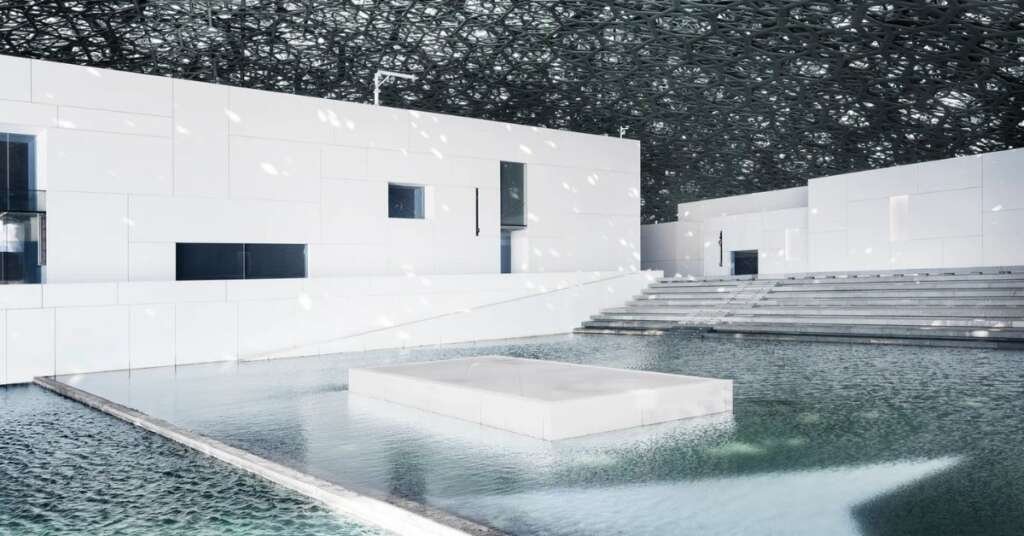
Reflective water features surrounding Louvre Abu Dhabi with the dome mirrored across the surface.
Credits: https://www.architecturaldigest.com/story/jean-nouvel-louvre-abu-dhabi
Designing for Climate
One of the most impressive aspects of Louvre Abu Dhabi Architecture is how effectively it responds to the harsh desert climate. Temperatures in Abu Dhabi can be extreme for much of the year.
Instead of relying solely on mechanical systems, the architecture incorporates passive environmental strategies inspired by traditional Middle Eastern design. These include:
- Extensive shading
- Narrow circulation spaces
- Controlled daylight penetration
- Water cooling effects
- Protected outdoor zones
The dome itself helps reduce direct solar gain while creating comfortable microclimates beneath it. This demonstrates an important architectural principle:
Good design works with climate, not against it.
In an era increasingly focused on sustainability, Louvre Abu Dhabi offers valuable lessons in environmental responsiveness.
A New Model for Cultural Architecture
Historically, many museums have organized collections according to geography or nationality. Louvre Abu Dhabi takes a different approach. Its curatorial philosophy focuses on shared human stories.
The architecture supports this idea beautifully.
Instead of emphasizing separation, the spatial experience encourages connection. Visitors encounter artworks from different civilizations and periods side by side, creating conversations between cultures rather than divisions.
The building itself becomes a symbol of cultural exchange.
Engineering Behind the Beauty
While visitors often focus on the dome’s visual impact, the engineering behind it is equally remarkable.
The dome weighs thousands of tonnes and consists of multiple layers of steel and aluminum assembled into an intricate geometric structure. Yet from many viewpoints, it appears almost weightless.
Achieving this effect required advanced structural engineering and precise fabrication techniques. The supporting structure is largely concealed, enhancing the illusion that the dome is floating above the museum.
This balance between engineering precision and architectural poetry is one of the project’s greatest achievements.
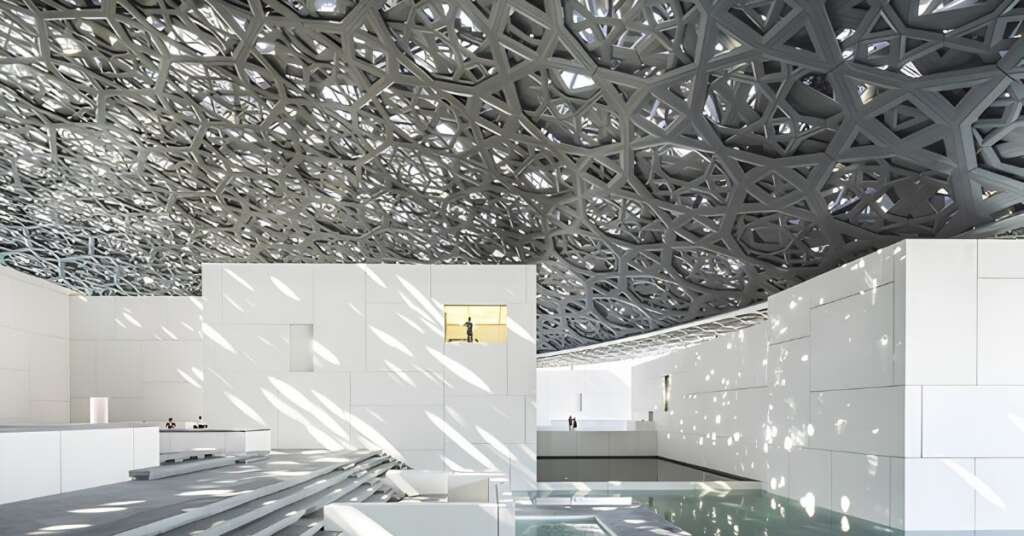
Close-up view of Louvre Abu Dhabi’s geometric dome structure showcasing intricate engineering and filtered daylight.
Why Architects Continue to Study Louvre Abu Dhabi
Since its completion, Louvre Abu Dhabi has become a global case study in architectural education. Architects admire the project because it successfully combines:
| Design Principle | How the Museum Demonstrates It |
| Contextual Design | Responds to local culture and climate |
| Innovation | Advanced structural engineering |
| Sustainability | Passive environmental strategies |
| Public Experience | Human-centered spatial design |
| Cultural Storytelling | Architecture reflects identity |
Many iconic buildings achieve one or two of these goals. Louvre Abu Dhabi manages to achieve all of them simultaneously.
That is rare.
Lessons for Future Architecture
The success of Louvre Abu Dhabi offers several important lessons for architects and designers.
First, technology should enhance experience, not dominate it.
Second, cultural identity remains essential even in contemporary architecture.
Third, climate-responsive design can be beautiful as well as practical.
Most importantly, architecture becomes memorable when it creates emotion. Visitors may not remember every engineering detail. But they remember how the light felt. How the spaces unfolded. How the building connected them to something larger than themselves.
That emotional response is what great architecture ultimately seeks to achieve.
Also Read: Wat Arun: Thailand’s Architectural Icon Along the Chao Phraya River
Final Thoughts
Louvre Abu Dhabi Architecture demonstrates that extraordinary buildings are not defined solely by form. They are defined by the experiences they create.
Through light, shadow, water, geometry, and cultural storytelling, Jean Nouvel transformed a museum into a living architectural landscape that constantly changes throughout the day.
The floating dome, the rain of light, the climate-responsive design, and the celebration of cultural exchange make Louvre Abu Dhabi one of the most important architectural landmarks of our time.
For architects, designers and anyone interested in the future of cultural spaces, it remains a powerful reminder that the best buildings do more than house art.
They become art themselves.