

Share This Article
Saudi Arabia’s ambitious The Line Project in NEOM once promised a radical transformation of urban living. But a new shift in priorities suggests something even more powerful — the rise of AI infrastructure as the backbone of future cities.
This move isn’t just a policy change. It signals a deeper urban and technological revolution shaping how tomorrow’s cities will actually function.
The Line: The World’s Most Radical Urban Experiment
When The Line was first announced, it did not feel like a normal real-estate launch. It felt like architecture trying to redraw the future in one stroke. A 170-kilometre linear city, wrapped in mirrored façades and placed across the Saudi desert, was presented not merely as a development, but as a total rethinking of how urban life could be organized. NEOM describes it as a city with no cars, no streets, and a reduced land footprint, designed to accommodate millions while preserving most of the surrounding landscape.
For architects, that proposition was impossible to ignore.
The Line was never just about size. Its real provocation was spatial. Instead of a city spreading outward in rings, sectors, and highways, this model compressed urban life into an ultra-narrow band. That alone challenged a century of conventional planning. Housing, mobility, public realm, services, and infrastructure were all meant to be stacked, layered, and synchronized inside a single continuous form. In architectural terms, it was less a city in the traditional sense and more an inhabited infrastructural section stretched across the landscape.
That is why The Line became such a powerful symbol.
It represented a new kind of urban imagination, one where form, technology, transportation, and environmental ambition were fused into a single mega-gesture. The mirrored exterior gave it a near-mythic visual identity, but beneath the surface, the project was really asking a serious question: can cities be reorganised around efficiency, proximity, and controlled density instead of roads, sprawl, and decentralised growth?
From a design perspective, that question still matters.
Even if the project changes in scale, The Line has already done what influential architecture often does best: it forced the discipline to confront its own assumptions. It challenged the idea that cities must expand horizontally. It questioned whether mobility has to depend on private cars. It suggested that the future of urbanism may not lie in adding smarter districts to old systems, but in rethinking the system itself from the ground up.
There was also a deeper architectural seduction to it.
The Line offered the kind of clarity architects rarely encounter at territorial scale. One bold geometry. One dominating idea. One continuous urban figure visible from the air and memorable in the public imagination. In an age when most cities grow through fragmented decisions, phased investments, and piecemeal compromises, The Line arrived as a singular, controlled vision. That made it both inspiring and controversial.
And perhaps that is exactly why it travelled so widely across the global design conversation.
To some, it looked like the future of climate-responsive urbanism. To others, it looked like an extreme abstraction, a city conceived more like an image than a lived civic fabric. Both readings were understandable. Yet that tension is what kept the project architecturally alive. The Line was never merely a Saudi megaproject; it became a global debate about whether radical urban form can genuinely improve human settlement, or whether it risks becoming detached from the social messiness that makes cities work.
What makes the story even more compelling today is that the original ambition was enormous. NEOM’s official vision for The Line still frames it as a high-density, transit-led urban model for up to 9 million residents with a compact footprint and end-to-end high-speed connectivity. But more recent reporting has pointed to major recalibration, with the broader NEOM vision facing strategic review and The Line itself being radically scaled back from earlier expectations.
That does not erase its architectural significance.
If anything, it sharpens it.
Because The Line now sits at the exact point where visionary architecture meets geopolitical economics, infrastructure logic, and technological reprioritization. It is no longer only a story about what architects can imagine. It is also a story about what nations choose to build when ambition meets reality.
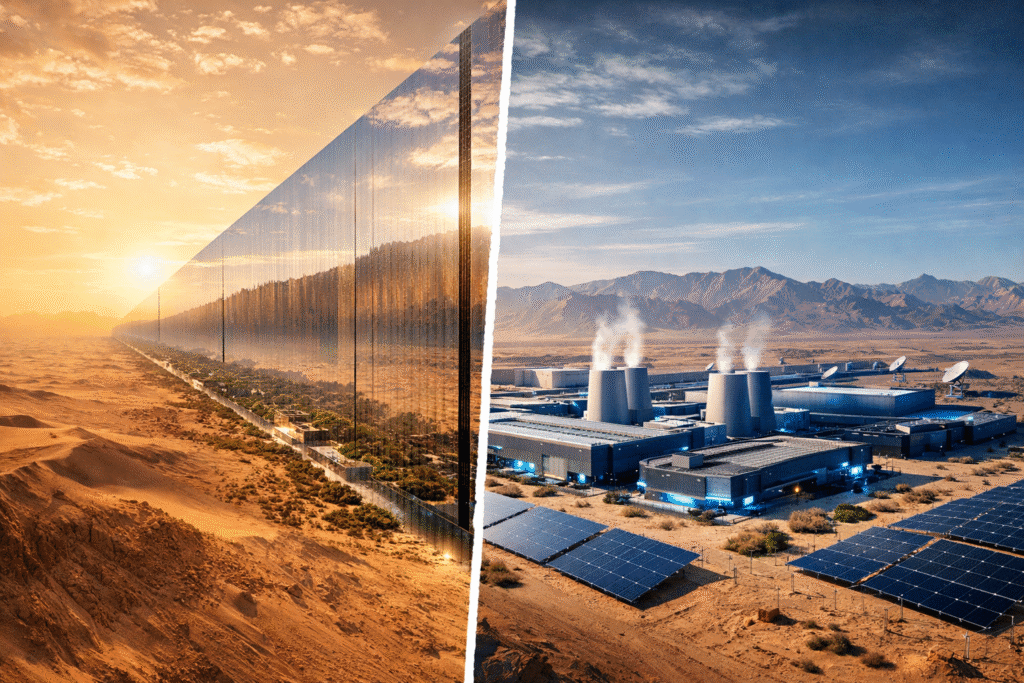
And that is where this shift becomes so important.
Also read this, What Does a 15-Minute City Mean?
The Line began as perhaps the world’s most radical urban experiment. But its deeper value may now lie in what it reveals about the changing relationship between spectacle, infrastructure, and power in the twenty-first century. For years, the project symbolised a future built for people through design. Today, as Saudi Arabia leans harder into AI infrastructure and data capacity, the conversation is beginning to move toward a different kind of built environment — one designed not only for residents, but also for computation.
That is what makes The Line so architecturally relevant even now.
It is still a project about the future.
But the future it points to may not be the one we first imagined.
The Hidden Challenge Behind Megaproject Architecture

Building a megaproject like The Line in Saudi Arabia is not simply an architectural challenge. It is a logistical operation on a scale that few cities in history have ever attempted.
From a distance, visionary projects often look elegant. Renderings show clean lines, seamless mobility systems, lush green corridors, and futuristic skylines cutting across pristine desert landscapes. But behind every megaproject lies a complex reality of engineering, infrastructure, and economic coordination that unfolds over decades.
For architects observing NEOM’s development, this is where the conversation becomes truly fascinating.
The Line was conceived as a 170-kilometer continuous urban structure, housing millions of residents within a narrow vertical city. The concept promised a radical departure from conventional urban sprawl: no roads, no cars, and every essential service reachable within minutes. It was a powerful design statement — one that challenged how cities expand, move, and consume land.
Yet the scale of that ambition introduces challenges that extend far beyond architectural drawings.
Constructing a single skyscraper already requires enormous coordination between structural engineers, contractors, material suppliers, and urban infrastructure networks. Now imagine multiplying that complexity across hundreds of kilometers of continuous construction, all within a remote desert environment.
The physical conditions alone demand extraordinary planning.
The Saudi desert terrain, with its shifting sands, extreme temperatures, and limited existing infrastructure, creates a difficult context for large-scale development. Every piece of construction equipment, every structural component, and every workforce deployment must be supported by temporary logistics networks before the city itself even begins to take shape.
In many ways, the real architecture of megaprojects happens underground and behind the scenes.
Energy networks, water desalination systems, transportation corridors, digital infrastructure, and cooling systems must all be established before the visible architecture can emerge. In projects like The Line, the invisible layers of infrastructure are almost as complex as the urban vision itself.
This is why many large-scale urban projects around the world evolve gradually rather than appearing overnight.
Megaproject architecture requires sustained economic momentum, political stability, and long-term financial commitment. Even nations with enormous resources must constantly reassess timelines, phases, and priorities as conditions change. The scale that makes these projects visionary also makes them vulnerable to shifting economic and technological realities.
And this is precisely where the conversation around Saudi Arabia’s architectural strategy becomes interesting today.
Recent discussions surrounding NEOM suggest that some of the kingdom’s ambitious construction timelines are being reconsidered as attention turns toward emerging technologies and digital infrastructure. Instead of focusing solely on monumental urban form, investment priorities are increasingly exploring sectors like artificial intelligence and computing infrastructure — industries that are rapidly redefining global economic power.
From an architectural perspective, this signals something deeper than a simple delay or redesign.
It reveals how infrastructure priorities are evolving in the 21st century.
For most of modern history, nations demonstrated power through visible construction — skyscrapers, highways, airports, and megacities. But today, a growing portion of national infrastructure is becoming invisible. Data centers, computing clusters, and AI infrastructure are quietly becoming as important as physical urban development.
The question for architects, therefore, is no longer only about how cities will look, but also about what kinds of infrastructure cities will need to support the digital age.
And that is where the story of The Line begins to intersect with a much larger global shift.
Because while the project may still represent one of the boldest urban ideas of our time, Saudi Arabia’s strategic focus appears to be expanding toward something even more fundamental: building the computational backbone that will power the next generation of cities.
The Great Shift: Why Saudi Arabia Is Pivoting Toward AI Data Centers
For years, projects like The Line in NEOM symbolized Saudi Arabia’s ambition to build some of the most futuristic urban environments on Earth. But as the global economy begins to revolve increasingly around artificial intelligence, a different type of infrastructure is quietly becoming just as important as cities themselves.
That infrastructure is AI data centers.
Around the world, the rapid rise of artificial intelligence is creating an unprecedented demand for computing power. Training large AI models, running cloud platforms, and supporting digital economies require enormous data processing facilities — massive campuses filled with servers, cooling systems, energy infrastructure, and ultra-fast connectivity.
In many ways, these facilities are becoming the factories of the digital age.
For Saudi Arabia, investing in AI infrastructure is not simply a technological decision. It is a strategic move aligned with the kingdom’s broader economic transformation under Vision 2030, which aims to diversify the economy beyond oil and position the country as a global technology hub.
This is where the narrative around The Line begins to intersect with a larger global transformation.
Megacities once represented the ultimate symbol of economic power. Today, however, the backbone of economic competitiveness is increasingly determined by computational capacity — the ability to process data, run artificial intelligence systems, and support large-scale digital platforms.
And that capability requires data centers at enormous scale.
Across the world, governments and technology companies are racing to build new data infrastructure to support AI. From the United States to Europe and Asia, vast campuses of servers and cooling towers are appearing in locations with strong energy capacity, reliable connectivity, and available land.
Saudi Arabia fits that equation in several important ways.
The kingdom possesses vast desert land, growing renewable energy investments, and the financial resources required to develop large technology ecosystems. Combined with NEOM’s ambition to become a futuristic hub for innovation, the development of AI data center infrastructure represents a logical next step in the country’s long-term strategy.
For architects and urban planners, this shift raises an intriguing question.
If the industrial revolution shaped cities around factories, and the automobile era shaped cities around highways, then the AI revolution may begin shaping cities around computing infrastructure.
Data centers, once hidden in anonymous industrial zones, are gradually becoming strategic pieces of national infrastructure. They require massive energy supply, sophisticated cooling technologies, and robust digital connectivity. In many cases, they also influence the planning of surrounding urban districts, research campuses, and technology ecosystems.
In other words, these structures are no longer invisible utilities.
They are becoming part of the architectural landscape of the future.
This is why Saudi Arabia’s increasing attention toward AI infrastructure signals more than a simple policy adjustment. It reflects a broader realization that the future of economic influence may depend as much on computational capacity as on physical urban expansion.
The Line may still represent one of the boldest urban visions of our time. But the rise of AI data centers suggests that the future of infrastructure may not always be visible as iconic architecture. Instead, it may emerge as vast digital engines quietly powering the cities of tomorrow.
And in that sense, the shift we are witnessing is not a retreat from ambition.
It is an evolution of it.
What Happens to The Line Now?
Despite the changing priorities around infrastructure and artificial intelligence, The Line is not disappearing. What is happening instead is a recalibration of scale and timeline.
Large-scale architectural visions often evolve as they move from concept to construction. Early renderings represent ambition, but real-world development requires adjustments based on cost, logistics, and long-term economic priorities.
The Line appears to be entering exactly that stage.
Rather than constructing the entire 170-kilometre city in one continuous push, the project is increasingly expected to develop in phases. Initial segments of the city could be built first, allowing infrastructure systems, transportation networks, and residential districts to grow gradually over time.
From an urban planning perspective, this approach is actually more common than many people realize.
Even some of the world’s most iconic cities expanded incrementally. Masterplans evolve, technologies change, and economic conditions reshape development strategies. What matters is not whether a project changes form, but whether its core vision remains adaptable.
For The Line, that vision still carries architectural significance.
The idea of a dense, transit-oriented urban corridor with minimal land footprint continues to influence discussions about future city planning, climate-responsive development, and sustainable urban density.
In that sense, scaling back does not necessarily mean abandoning the idea.
Instead, it may simply reflect a shift toward building the project more realistically and strategically.
The Future of Architecture in the Age of AI Infrastructure
As artificial intelligence becomes central to the global economy, the built environment will inevitably adapt around it.
For architects, this introduces a new layer of urban infrastructure that previous generations rarely had to consider. Data centers, computing clusters, energy networks, and high-speed connectivity systems are rapidly becoming as important to cities as transportation or housing.
In many ways, AI infrastructure is becoming the hidden architecture of the digital era.
These facilities demand enormous power supply, advanced cooling systems, and strategic geographic placement. They also influence where technology companies cluster, where research hubs develop, and how digital economies expand.
This means architecture is no longer designing cities only for people.
Increasingly, it is designing environments that support machines, computation, and data ecosystems.
Also read, Designing the Future: How Young Creatives are Reshaping Architecture
Saudi Arabia’s shift toward building AI infrastructure alongside its ambitious urban projects highlights this transition clearly. The country is not simply constructing futuristic buildings; it is attempting to position itself within the technological networks that will define the next generation of global innovation.
For architects and urban planners, this moment represents an important turning point.
The cities of tomorrow may not only be defined by skylines and landmarks. They may also be shaped by invisible systems of computation that quietly power transportation, communication, and entire digital economies.
Architecture, therefore, is entering a new phase — one where the relationship between urban form and technological infrastructure becomes more intertwined than ever before.
Conclusion
The story of The Line was never only about building a city in the desert.
It was about imagining how cities themselves might evolve in the future.
Today, Saudi Arabia appears to be making a strategic shift — balancing its bold architectural ambitions with the growing importance of artificial intelligence infrastructure.
Megacities may still capture the world’s imagination.
But the true engines of the future may lie in the vast digital networks and computing power quietly shaping the global economy.
And for architecture, that shift could redefine what it means to build the cities of tomorrow.