

Share This Article
Most houses are built to look impressive.
A courtyard house is built to feel comfortable.
That difference may sound subtle, but it changes everything — how the home breathes, how it cools, how it lights up, and how it supports daily life. And in a country like India, where climate is not a background detail but a daily reality, courtyard house design becomes more than an aesthetic choice.
In fact, courtyard homes are one of the most CLIMATE-SMART ways to design a house today.
What is Courtyard House Design?
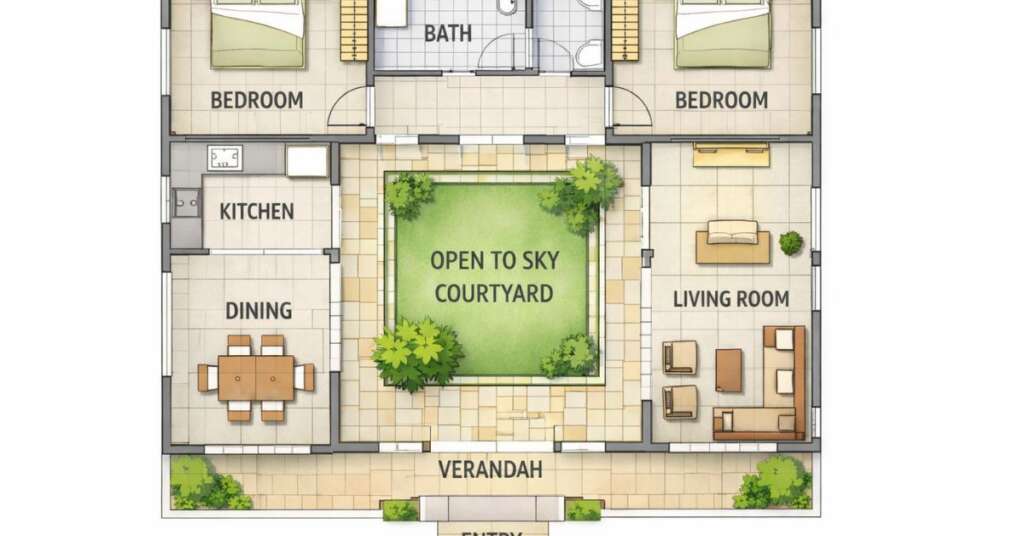
Courtyard house design is a planning method where the home is arranged around an open space — usually an open-to-sky courtyard. This courtyard is not leftover area. It is a deliberate architectural element that controls light, ventilation, privacy, and even the emotional experience of the home.
In traditional Indian courtyard houses, the “aangan” was the heart of the home. It wasn’t built for trends. It was built because it worked. The courtyard created a natural buffer between harsh outdoor conditions and indoor comfort.
Modern courtyard house design follows the same logic, but with updated materials, cleaner lines, and contemporary lifestyle planning.
🔗 courtyard concept in architecture
Why Courtyard House Design is a CLIMATE-SMART Choice in 2026
Let’s be honest — most modern houses are designed like sealed boxes. They depend heavily on artificial cooling, artificial lighting, and mechanical ventilation. That approach is expensive, uncomfortable in power cuts, and often unhealthy for long-term living.
Courtyard house design works differently. It uses passive design strategies that allow the home to breathe naturally. Instead of resisting the climate, it collaborates with it. This is exactly what climate responsive architecture has been teaching for decades.
A well-planned courtyard home can reduce indoor heat, improve air movement, and create softer daylight without the harsh glare that most Indian homes struggle with.
In short, courtyard homes are CLIMATE-SMART because they reduce dependency.
Benefits of Courtyard House Design (Architect’s Perspective)
Courtyard house benefits go far beyond “it looks nice.” In practice, courtyards influence how a home performs every single day. After 15 years of working with residential projects, I can tell you one thing clearly: the best homes are not the ones with the most expensive finishes. They are the ones with the smartest spatial planning.
A courtyard creates a central breathing space. It allows warm air to rise and escape, while cooler air is pulled through the rooms. This is why courtyard ventilation is one of the strongest passive cooling strategies in hot climates.
Just as importantly, a courtyard brings in daylight from above. That light is softer and more evenly distributed. It improves indoor comfort, reduces artificial lighting, and makes the home feel naturally alive.
Two benefits that matter most in India:
- Better natural ventilation without compromising privacy
- Better daylighting in architecture without excessive heat gain
I

Courtyard House Planning Tips (That Actually Decide Success)
Courtyard house planning is where most designs either succeed beautifully or fail quietly. Many people think a courtyard is simply an open square in the middle. In reality, it’s a climatic device, a privacy buffer, and a spatial organizer — all at once.
The first step is deciding what the courtyard is meant to do. Is it for ventilation? Is it for light? Is it for greenery? Or is it for family gatherings? When the purpose is unclear, the courtyard becomes a decorative gap rather than a functional heart.
Next comes sizing and proportion. If the courtyard is too narrow, it becomes dark and stagnant. If it is too large, it becomes harsh and exposed. The sweet spot is always proportional to the home’s layout and the sun path.
Two planning rules I use often:
- Don’t design a courtyard without a clear purpose
- Never ignore orientation and shading, especially in India
Courtyard Types: Choosing the Right Layout
Not every courtyard house plan needs a central courtyard. In fact, some of the best courtyard home designs today use side courtyards or L-shaped courtyards because they suit urban plots better. The type of courtyard you choose should depend on plot width, privacy needs, and how you want to zone the house.
A central courtyard house is excellent for privacy and a strong inward-looking character. It creates a calm, insulated world inside the home. A side courtyard works better for narrow plots, giving you light and ventilation without sacrificing too much buildable area.
Multiple courtyards are the most luxurious and the most CLIMATE-SMART when designed well. They allow separate microclimates — one for public spaces and another for private rooms.
Most practical courtyard types:
- Central courtyard house plan (classic and private)
- Side or L-shaped courtyard (best for modern urban plots)
The Biggest Courtyard Design Mistakes (And Why They Happen)
Courtyard house design looks simple, which is why many people underestimate it. The most common mistake is treating the courtyard as a visual feature rather than a performance feature. A courtyard should not exist just for Instagram. It should exist because it improves comfort.
Another mistake is ignoring shading. Without shading, courtyards become heat traps. This is especially true for west-facing courtyards in India. A beautiful courtyard without shade will make surrounding rooms hotter, not cooler. And that defeats the entire purpose of climate-smart architecture.
The third major mistake is poor drainage. Because the courtyard is open-to-sky, rainwater management must be designed like an engineer. Otherwise, seepage and dampness become long-term problems.
Two mistakes you must avoid:
- Designing an exposed courtyard without shading
- Ignoring drainage + waterproofing from day one
CLIMATE-SMART Courtyard Design Ideas That Work in Real Homes
A courtyard becomes truly successful when it’s designed as a lived-in space, not an empty void. One of the best ways to improve comfort is adding greenery. Plants soften heat, improve air quality, and reduce the harshness of sunlight. Even a small tree can transform the microclimate.
Water elements also work well when used subtly. You don’t need a fountain. A shallow water tray or small pond can cool the air slightly and create calming sound. These are small moves, but in architecture, small moves often create the biggest difference.
Jaali screens and pergolas are another powerful addition. They filter light, create shadow patterns, and allow airflow while maintaining privacy. In my opinion, jaalis are one of India’s most underused climate-smart design tools.
Two CLIMATE-SMART upgrades:
- Add shade + greenery to create a microclimate
- Use jaali/pergola to filter sun without blocking air
Courtyard House Design Examples (Traditional + Modern)
Traditional Indian courtyard houses were not built with fancy technology. They were built with intelligence. The courtyard supported daily routines — cooking, washing, gathering, and resting. It allowed smoke to escape, brought in light, and created thermal comfort. It was architecture responding to climate and culture simultaneously.
Modern courtyard house design takes that intelligence and adapts it. Today’s courtyard homes are cleaner, more minimal, and often connected to living and dining spaces. The courtyard becomes a visual anchor, a light source, and a private outdoor room. It also supports the modern desire for indoor-outdoor living without sacrificing security.
Even small houses can benefit from a courtyard. In compact plots, a courtyard can be a light court or a ventilation shaft. When designed correctly, even a modest courtyard improves comfort far more than expensive interiors ever will.
“What is Courtyard House Design?”
Courtyard planning isn’t a trend — it’s a climate-tested strategy, and the research-backed explanation of the science behind courtyard homes in India makes that very clear.
Is Courtyard House Design Good for Small Plots?
Yes — and this is where smart planning matters most.
Small plots often suffer from poor ventilation and limited daylight because of tight setbacks and adjacent buildings. A courtyard becomes a vertical opening that pulls in light and allows air movement. Even a 2.4m x 2.4m courtyard can change how a house feels.
The trick is not making it too narrow and not leaving it empty. If you treat it like a small room — with a floor finish, greenery, and a seating edge — it becomes usable and beautiful.
Two tips for small courtyard homes:
- Keep courtyard width at least 8 feet for useful light
- Design it like a space, not like leftover area
FAQ: Courtyard House Design (Quick Answers)
Is courtyard house design good for Indian climate?
Yes. Courtyard house design in India is ideal for hot climates because it supports passive cooling, natural ventilation, and controlled daylight.
What is the best courtyard size for a house?
For meaningful light and airflow, aim for at least 2.4m (8 feet) width. Larger homes typically use 3m–5m courtyards.
Are courtyard houses expensive?
Not necessarily. A courtyard house plan can reduce energy usage long-term. The cost depends more on finishes than the courtyard itself.
What is the biggest disadvantage of courtyard homes?
If shading, drainage, and waterproofing are poorly planned, courtyards can cause heat gain, seepage, and maintenance issues.
Conclusion: Courtyard Homes Aren’t Old — They’re CLIMATE-SMART
If you ask me what the most future-proof home design strategy is for India, I won’t say “smart gadgets” or “luxury finishes.” I’ll say this: plan the house to work with climate.
Courtyard house design is not nostalgia. It is CLIMATE-SMART architecture that solves comfort logically. It gives you natural ventilation, privacy, soft daylight, and a daily connection to nature — without forcing your home to depend on machines.
A courtyard house doesn’t just look good.
It performs.
And in real life, performance is the real luxury.