


Share This Article
Some architecture is seen.
Some is experienced.
And then there is Peter Zumthor.
His work does not reveal itself instantly.
It unfolds slowly, through light, texture, and silence.
In a world where buildings compete for attention, his architecture invites you to pause. And in that pause, something rare happens — you begin to truly feel the space around you.
If you enjoy exploring inspiring architecture and deeply experiential design philosophies, you can discover more curated insights on SMART.POV
Who Is Peter Zumthor?
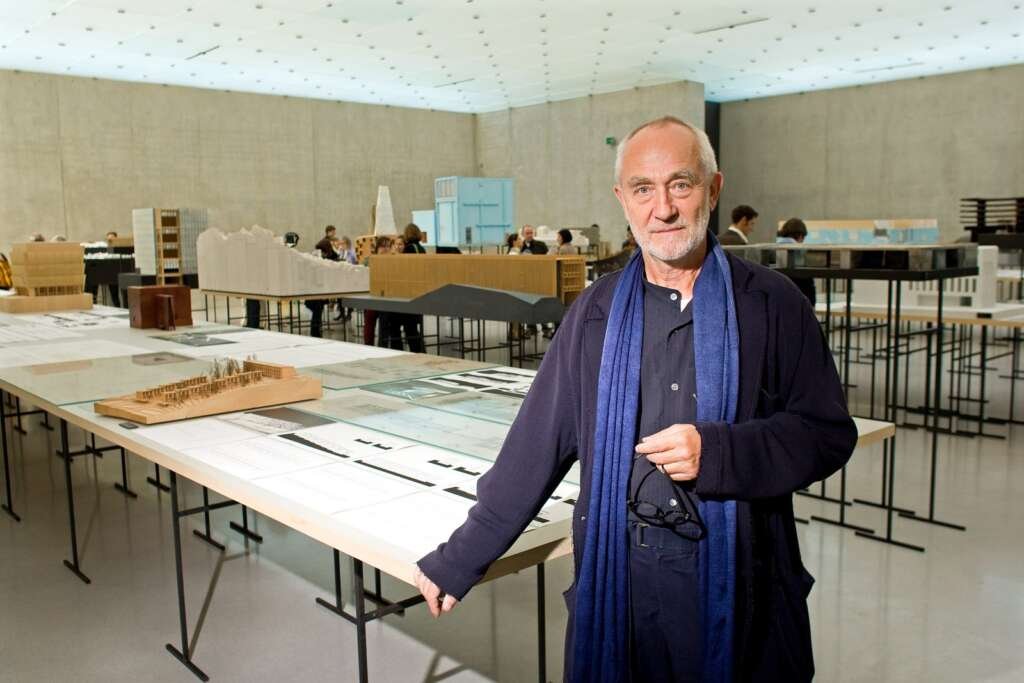
Peter Zumthor stands among the most respected voices in contemporary architecture, not because of the number of projects he has built, but because of the depth with which he approaches each one.
Based in Switzerland, his work is rooted in a philosophy that prioritizes human experience over visual spectacle. Unlike many architects who chase recognition through bold forms, Zumthor focuses on creating spaces that engage the senses and remain etched in memory.
His contribution to architecture was recognized with the prestigious Pritzker Architecture Prize, an honor that celebrates not just design excellence, but a profound impact on the discipline itself.
What makes Peter Zumthor architecture truly inspiring is its timelessness. His buildings do not follow trends, and therefore, they do not age with them. They exist quietly, yet powerfully, in their own space.
The Philosophy of Peter Zumthor Architecture
At the core of Peter Zumthor architecture lies a belief that challenges conventional design thinking — that atmosphere is more important than form.
While many architects focus on how a building is perceived visually, Zumthor is concerned with how it is experienced emotionally. He designs not for the eye alone, but for the entire human body.
As an architect, this perspective feels both refreshing and demanding. It requires a deeper level of sensitivity, where every decision — from material to proportion — must contribute to a larger emotional narrative.
His spaces are never overloaded with elements. Instead, they are carefully distilled to their essence, allowing each component to carry meaning.
This is what makes his work not just minimal, but deeply intentional.
This sensitivity toward materials and atmosphere can also be seen in the works of Tadao Ando, whose minimalist approach similarly emphasizes light, texture, and emotional depth.
Designing for the Senses

One of the most remarkable aspects of Peter Zumthor architecture is its ability to engage all the senses simultaneously.
His spaces are not designed to be visually consumed in a single glance. They are meant to be experienced over time, as you move through them. The sound of footsteps echoing against stone, the cool touch of a wall, the subtle shift in light as the day progresses — these are not accidental occurrences, but carefully orchestrated elements.
Materials, in his work, are chosen not just for their appearance, but for their sensory qualities. Light is not used to simply illuminate; it is used to shape perception. Even silence becomes a design tool, creating moments of reflection within the space.
This layered experience is what makes his architecture so deeply inspiring. It does not impose itself on you. It invites you to engage with it.
Iconic Project: Therme Vals


The Therme Vals in Switzerland stands as one of the most compelling examples of Peter Zumthor architecture.
At first glance, the structure appears almost understated, blending seamlessly into the landscape. But the true experience begins once you step inside.
The building is composed of carefully arranged stone volumes, creating a sequence of spaces that unfold gradually. Water plays a central role, guiding movement and enhancing the sensory experience. Each chamber offers a different atmosphere, defined by variations in light, temperature, and spatial enclosure.
There is a rhythm to the space, almost like a composition, where each element contributes to a larger experiential narrative.
What makes Therme Vals truly inspiring is not its form, but the journey it creates. It is architecture that must be lived, not just observed.
Materiality: Architecture That You Can Feel
For Peter Zumthor, materials are not merely construction elements — they are the very soul of architecture.
He approaches material selection with an extraordinary level of sensitivity, considering not just how something looks, but how it feels, how it ages, and how it interacts with the human senses over time. Texture becomes something you instinctively respond to, sound subtly shapes the atmosphere of a space, and the way a material evolves with age adds a layer of depth that cannot be artificially created.
This attention to detail results in spaces that feel authentic and deeply grounded.
Unlike polished and overly refined finishes, Zumthor’s materials are often raw, natural, and honest. They are allowed to weather, to change, and to develop character over time. This transformation is not seen as imperfection, but as an essential part of the architectural experience.
What emerges is a powerful connection between the building and its users — a quiet understanding that the architecture is not static, but alive and evolving with time.
Light and Shadow: Creating Emotional Depth
Light in Peter Zumthor architecture is never incidental. It is carefully composed, almost like a material in its own right.
Rather than flooding spaces with uniform brightness, Zumthor uses light to create contrast, to reveal textures, and to guide movement. As light interacts with surfaces, it produces shadows that add depth and dimension, transforming even the simplest forms into rich spatial experiences.
These subtle shifts in light and shadow create environments that feel dynamic yet calm. They change throughout the day, offering a different experience each time.
This ability to shape emotion through light is what elevates his work from architecture to something closer to art.
The Role of Silence in Design
One of the most unique qualities of Peter Zumthor architecture is its sense of silence.
Not just the absence of noise, but the presence of stillness.
His spaces encourage a slower pace, inviting users to become more aware of their surroundings. There is no urgency, no visual clutter demanding attention. Instead, there is space to breathe, to observe, and to reflect.
In today’s fast-moving world, this quality feels almost radical.
As architects, we often feel the need to add more — more elements, more features, more complexity. Zumthor reminds us that sometimes, the most powerful design decision is to remove what is unnecessary.
Conclusion
Peter Zumthor architecture stands as a profound reminder that the true value of design lies not in how it looks, but in how it makes people feel.
His work does not rely on spectacle or trend-driven aesthetics. It relies on understanding — of materials, of light, and most importantly, of human experience.
That is what makes it truly inspiring.
His philosophy continues to influence architects globally, with further insights into his work available through Peter Zumthor Studio.
In a world that often celebrates speed and visual impact, Zumthor offers something far more enduring — spaces that invite stillness, reflection, and connection.
And perhaps that is the future of architecture. Not louder buildings, but deeper ones.